Four million parliament records move to UK National Archives, including the 1605 act behind Bonfire Night
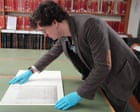
The transfer of four million records from the archives of parliament to the National Archives is now complete. The project to move the records to the National Archives at Kew, in south-west London, began five years ago. The collection's notable documents have come into focus as Bonfire Night approaches and firework displays light up the UK.
One of the collection's gems is the 1605 Thanksgiving Act. It was passed by James I after Guy Fawkes failed that year to assassinate the king, the Lords and the Commons at the opening of parliament.
The act celebrated the deliverance of the Protestant church and directed that church services be held every 5 November to commemorate the failure of the Gunpowder Plot. The document survives as a flat vellum page inscribed in exquisite calligraphy at the National Archives.
Dr Graham Moore, an early modern parliament specialist at the National Archives, said these acts often have very flowery beginnings: the first section lays out the reasons for the act before the legislation itself follows. He also pointed to a humorous passage in the act about King James I and VI.
The collection includes an incredibly well-preserved journal for the House of Commons, the precursor of Hansard. A handwritten entry in its margin, written by the Commons clerk on 5 November 1605, tells of the search of the Palace of Westminster cellars and the discovery of 36 barrels of gunpowder along with Guy Fawkes.
A separate scroll, an Act of Attainder, declared Guy Fawkes and his co-conspirators guilty of treason and decreed they were to be hanged, drawn and quartered.
Dr Moore said little additions stitched onto the vellum can be seen; the bill was laid in the House and then edited as it was debated, leaving crossings out and additions stitched on top.
The transfer from Victoria Tower at the Palace of Westminster to Kew has added 16.5 linear kilometres of records to the 174.5 linear kilometres already housed there. The records are now fully catalogued, each marked with its own registration barcode, and available for the public to order and view for free at a venue better suited to long-term preservation and access.
Not only documents have been transferred. The collection includes a suffragette's banner from 28 October 1908, secretly taken into the Ladies' Gallery in the Commons chamber; one suffragette dropped the banner into the chamber while two others chained themselves to the gallery's iron grille, and the grille had to be removed with the two still attached. A piece of a gravestone, a sword and a uniform are among the more unusual items.
The largest document is the 1821 Land Tax Commissioners Act, the longest act in the archives of parliament. It nominates 65,000 commissioners to collect revenue based on land valuations, and inscribed on 757 vellum membranes it totals 348 metres in length, more than three football fields.
Another document is the Great Reform Act of 1832. Dr Joe Cozens, a 19th-century parliament records specialist at the National Archives, described it as a really important constitutional document that first admitted middle-class men in the borough towns to the franchise.
The National Archives is now responsible for a total of 20 million records, with one-third housed in deep storage in Cheshire. Chief executive Saul Nassé said the Palace of Westminster was not designed with modern preservation standards in mind; with parliament's records added to those of the judiciary and government, the three arms of the British state are now in one place, offering the public more access than ever before.