
Industrial areas flare for a third day over the Tk30,000 wage demand, as politicians urge government and opposition to sit at one table
Garment workers have been protesting for the past three days demanding a minimum wage of Tk30,000. In Dhaka, Gazipur, Narayanganj, Savar-Ashulia and other industrial areas, they have clashed repeatedly with police.
Most recently on Tuesday (3 November), tensions flared repeatedly in Gazipur, Narayanganj, Savar-Ashulia and Dhaka's Mirpur. Demonstrations blocked roads, and metro rail services were disrupted from the Mirpur-14 area. In this situation, several hundred factories have been closed and holidays declared.
Meanwhile, the government formed a wage board on 1 November. The Ministry of Labour and Employment issued two separate notifications on the matter, later published in gazette form. The board for the garment industry was formed under subsections 3(a) and 3(b) of section 138 of the Bangladesh Labour Act 2006 (amended 2026), using the powers given there, and to carry out the functions set in section 139.
At first, however, no specific date was announced for when the board would meet. Several garment workers said they had taken to the streets out of a sense of grievance. They believe workers' pay was due to rise from December; if the government delays the meeting, uncertainty could grow over that.
Against that backdrop, wage board secretary Raisa Afroz said a notice for the board's first meeting to reset garment sector wages would be issued by Tuesday or Wednesday. A member of the board said they hoped to sit for the first meeting on Thursday; if the meeting did not happen, starting work would be delayed further. He also said that with three days passed since the board was formed without a meeting, pressure was coming from worker leaders and various sides.
The six-member board formed on Sunday is chaired by Senior District and Sessions Judge Sheikh Ashfaqur Rahman. Labour and Employment Minister Ariful Haque Chowdhury announced the board's formation at a press conference at the Secretariat. Representing the owners are BGMEA director A B M Shamsuddin and Asif Ayub, joint secretary general of the Bangladesh Employers' Federation. Representing the workers are Anwar Hossain, president of the Bangladesh Jatiyatabadi Sramik Dal, and Babul Akhtar, general secretary of the Bangladesh Garments and Industrial Workers Federation. The neutral member is University of Dhaka professor Mosleh Uddin Ahmad. The board will recommend minimum wages for workers in the various grades of the garment industry; on the basis of that recommendation, the government will announce a new wage structure by gazette. The minimum wage was last set at Tk12,500 in December 2023. Wages used to be reset every five years; the Labour Act amendment passed in Parliament on 10 April cut that period to three years.
On the question of instigation behind the unrest, the government and the opposition have made almost the same allegation. After a meeting with the prime minister at the Secretariat on 1 November, Home Minister Salah Uddin Ahmad told reporters that instigation was coming from across the border and that the government would deal with it politically. On 2 November, the chief of the main opposition party Jamaat-e-Islami and leader of the opposition, Dr Shafiqur Rahman, said conspirators and profiteers might be instigating the ongoing unrest in the garment industry, and that the government must take a tough stance to foil attempts to destroy the industry by inflaming the situation.
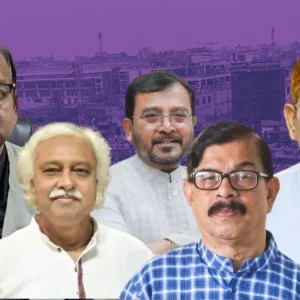
Politicians have expressed concern that the worker unrest has not stopped. Some say a political evil force is instigating it; others allege the government is failing to control the situation. In their view, urgent steps are needed to resolve the crisis, otherwise it could spiral out of control. Some politicians have urged the government and the opposition to sit at one table to resolve the crisis.
BNP vice chairman Shamsuzzaman Dudu said: 'There is not much distance between the workers' demands and the government. That is why the wage board has been formed. But there are more processes after a board is formed. Even holding the board's meeting takes at least a month or two. But in the meantime, vandalism and arson have begun in various places.' Asked who might be involved, he said detainees picked up for sabotage in various places had been seen to be linked to the banned organisation Chhatra League, and foreign forces might also be instigating the situation. He said the government, owners and workers must all stay alert so that no one can create a different situation now to gain illegal advantage.
Dr Hamidur Rahman Azad, assistant secretary general of Bangladesh Jamaat-e-Islami and a former MP, said ensuring workers' rights and maintaining the industry's stability is the government's responsibility. At the same time, if anyone uses the workers' fair movement as an opportunity to create instability, violence or damage to factories, they must be identified through an impartial investigation and face legal action.
Mahmudur Rahman Manna, president of Nagarik Oikya, said: 'It is hard for workers to bear the cost of living on Tk15,000-16,000. And even Tk30,000 is not enough for many to manage fully. So the government's decision to form a wage board is timely. But the tension has spread because of indecision by the government and the BGMEA. The government delayed instead of taking the main initiative.' He added that the government should see workers as workers; some may try to create an issue around the ongoing movement. What is urgent now, he said, is for the government to discuss with everyone to resolve the crisis — if necessary, it can sit at one table with the opposition and other political parties.
Ruhin Hossain Prince, former general secretary of the Communist Party of Bangladesh (CPB), said the crisis was created because the government and the BGMEA did not play their fair role in time. In his words, under the Labour Act the minimum wage is to be set every three years, so pay was due to rise from December. The government should have formed the wage board much earlier. Past experience shows that after a board is formed it takes six months or more to set wages; yet October has passed and November has arrived — creating doubt and uncertainty among workers over whether pay will rise from December. Meanwhile, government employees' pay and allowances have risen, while ordinary people's incomes have fallen and life has become harder.
Prince added that if, when forming the board, the government had clearly said the new minimum wage would take effect from December and that December's pay would be given at the increased rate in January, much of the crisis would have been resolved. In his view there are other causes of worker discontent — low pay, an unsound working environment, and women workers facing various forms of harassment. Many workers dismissed over the years for various reasons are blacklisted so they cannot get jobs elsewhere, which he called illegal. To normalise the situation, he demanded the unconditional release of workers arrested over the movement, an announcement that those involved in torturing workers will be identified and acted against, and an announcement now that the wage board will sit quickly and the new minimum wage will take effect from December. Such an announcement, he believes, would remove much of the discontent. He said that when pay rises, workers' productivity also rises; exports and earnings have not fallen, and the government and the BGMEA must play their role so that workers also receive their fair share of that income.
Mujibur Rahman Manju, chairman of the Amar Bangladesh Party (AB Party), said: 'Since the government announced the ninth pay scale, we had assumed strong demands for pay rises would come from other working and professional people in the country. In that context, the workers' demand is quite logical. But the conspiracy to turn this movement violent is already clear. The government deserves thanks for forming the wage board. Now, I believe a solution is possible for the time being if a logical pay scale is announced quickly.'


