AB Party calls for fair wages alongside protecting garment industry capacity, seeks wage structure recommendation in 15 days

The Amar Bangladesh Party (AB Party) has called for ensuring fair wages for workers alongside protecting the production and competitive capacity of the garment industry, as a lasting solution to the ongoing labour unrest and crisis in the sector. The party said the government's failure to resolve the labour unrest is putting this important industry at risk.
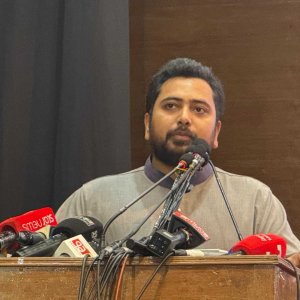
AB Party chairman Mojibur Rahman Manju made the remarks at a press conference at the party's central office in the capital's Bijoy Nagar on Thursday (5 November). At the press conference, conducted by labour affairs secretary Shah Abdur Rahman, joint general secretary Barrister Abbas Islam Khan Noman presented various demands on behalf of the party.
Manju said workers' rights and the interests of the garment industry are not contradictory. Workers must be paid fair wages, and at the same time the industry's employment and production capacity must be protected. But if workers' rights and the industry's protection cannot be ensured, the government will have to take the responsibility, he said.
He said more than 80 percent of the country's export earnings come from the ready-made garment industry and about 4 million workers are directly linked to it. The garment crisis is therefore not only a business problem for owners; it is a question of the national economy and the livelihoods of millions of families. With prices, house rent, medical and transport costs having risen as they have, workers' lives on the current wage have become difficult, he said, calling for the workers' demand for a Tk 30,000 minimum wage to be considered seriously.
Noting that Bangladesh's garment industry faces intense competition in the international market, he said that although production, energy and financing costs have risen, international buyers in many cases are not paying a fair price for products. Leaving the full pressure of a wage increase only on factory owners could push small and medium factories into crisis. International brands and buyers must also take responsibility for ensuring workers' fair wages, he said.
Criticising the role of political activists in tackling the labour unrest, Manju said maintaining law and order is not the duty of any political party's leaders and activists. Despite the police, industrial police and other law enforcement agencies existing, BNP leaders and activists are being seen taking to the streets with sticks, and there have also been reports of a local member of parliament being present. The Awami League made the same mistake, he said, adding that fielding political workers in the name of controlling a labour movement weakens state institutions and creates the risk of new conflict.
Raising the BNP's past position, he said that while in opposition the BNP had demanded a minimum wage of Tk 23,000 for garment workers. On the other hand, Ganosamhati Andolan chief coordinator and current state minister for planning Jonayed Saki had also previously backed a demand for a Tk 25,000 wage. Their position now on the workers' Tk 30,000 demand needs to be clarified, he said.
Criticising the delay in forming the wage board, he said that although the initiative was taken on 15 October, it took until 1 November to formally form the board, and the first meeting was held on 4 November. Workers' demands and unrest cannot be viewed only as a law and order problem; it is a question of economic and social justice, he said.
Demanding a neutral investigation into the death of worker Toufik Hossain in Gazipur, Manju said who is responsible for the death, who was involved in attacks on workers and whether law enforcement agencies performed their duties properly must be investigated and made public. Any allegations of infiltration, incitement, vandalism or sabotage in the movement must also be proved through a neutral investigation, and those involved in vandalism and arson must be arrested and brought to justice, he said.
At the press conference, Barrister Abbas Islam Khan Noman demanded that the current wage board be made effective and the recommendation for a new wage structure be finalised within the next 15 days, and that a roadmap for an implementable wage increase be announced through discussion, giving importance to the workers' demand for a Tk 30,000 minimum wage. Even if the wage is increased in phases if necessary, the amount of each phase and its effective date must be set, he said.
Noman said the garment industry cannot be sustained in the long term by cutting workers' wages or suppressing the movement, and workers' rights will not be established through vandalism, arson and violence either. He spoke of a justice-based wage, responsible ownership, a skilled and productive workforce and an accountable government, and called for a long-term, integrated national garment industry and labour policy.
Present at the press conference were joint general secretaries Advocate Abdullah Al Mamun Rana and ABM Khalid Hasan, Dhaka metropolitan north convener Selim Khan, metropolitan south convener Abdul Halim Khokon, Sramik Party coordinator Jamal Sheikh, metropolitan south member secretary Barkaz Nasir Ahmad, assistant office secretary Abdul Halim Nannu, Mohsinul Haque Chowdhury, Moshiur Rahman Milu, labour leader Baby Pathan, Gaibandha district joint convener Tajul Islam, Ramna Thana convener Abdul Kader Munshi and Paltan Thana member Abdul Quddus.