Mangoes still hanging in November at Gomostapur orchard, scion sales earn about Tk 500,000
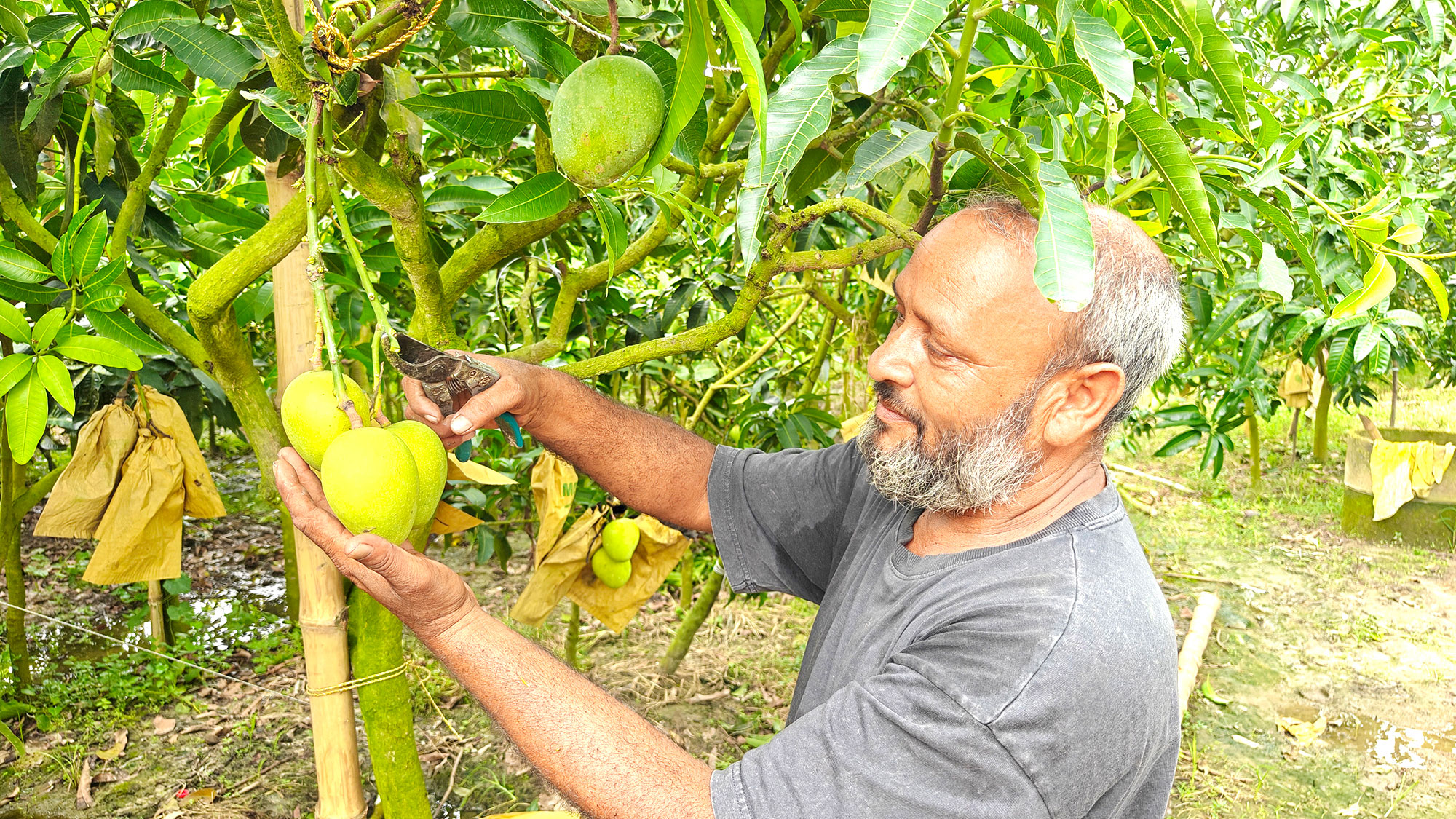
The mango season ended long ago. Himsagar, Langra, Fazli and Amrapali have one by one disappeared from the markets. Yet in Khairabad, in the Rahanpur municipal area of Gomostapur upazila in Chapainawabganj, bunches of mangoes can still be seen hanging from the trees.
Katimon mangoes hang on some trees and Kalyanbhog on others. There are also some mangoes whose variety even the orchard owner himself does not yet know. Seeing trees full of mangoes even in November, many passers-by stop and ask whether mangoes are still available.
Behind the orchard is Rabiul Islam Rabi. Working with trees, saplings, scions and mango varieties for nearly three decades, he has built a mango orchard covering 12 bigha. His orchard contains not only common varieties, but also off-season bearing varieties, varieties brought from abroad and varieties planted experimentally.
The orchard includes Katimon, Khirsapati, Gourmati, Ilamati, Sandy, Chiaimai, Red Palmer, King of Chapati, Honeydew, Bari-7, Amrapali, Bari-4 and Kalyanbhog, among many other varieties.
Selling scions has now become his business venture. In 2024, he earned Tk 34,500 from selling Kalyanbhog scions. In 2025, that rose to about Tk 200,000. By September of this year, he had already earned about Tk 500,000.
Rabiul Islam said, “After passing my SSC in 1997, I started a nursery business while still a student. Gradually I began creating mother trees to identify the correct mango varieties. From then on I felt the importance and necessity of commercial mango orchards.”
He said that in 2018 he decided not only to run a nursery but to grow a commercial mango orchard himself. He leased just one and a half bigha of land, planted Kalyanbhog scions there and tended the trees himself. He then gradually began grafting scions of other varieties as well.
When a variety produced well, he increased its number. When he heard of a new variety, he collected its scions. And when he had doubts about a variety, he planted a few trees experimentally and waited for the yield. In this way the orchard gradually grew to its present 12 bigha.
Instead of rows of a single type of tree, Rabi's orchard has different varieties side by side. Some varieties bear fruit quickly, others late. Some are common in the market, while local farmers know very little about others.
He collects scions of different varieties from home and abroad and plants them experimentally in his own orchard. Rabi said, “I bring in scions of new varieties from home and abroad and work with them experimentally. Work is still going on with several varieties.”
His aim is to find which varieties perform well in Chapainawabganj's soil and climate. Rabiul Islam's dream is that people in the country should be able to eat mangoes at low prices throughout the year, not only during the mango season.