Latin American banana growers demand fair pay as climate crisis cuts output
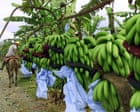
Banana producers in Latin America are calling for better pay to help cope with the impact of the climate crisis, as extreme weather during this year’s super El Niño event has caused big drops in their production.
The Fairtrade Foundation, an ethical trade body, said high winds in parts of Colombia and heavy rainfall in Peru and Ecuador are already affecting production. In the Dominican Republic, farmers are expected to face drought conditions, with forecasts of drier and warmer than usual weather this year.
Fairtrade research suggests that during the previous El Niño cycle, productivity across its farmers and workers dropped by 13% in the Dominican Republic, 22% in Ecuador and 6% in Peru compared with the year before. The El Niño event in 1983 — one of the strongest ever recorded — affected 15% of the total planted banana area in Ecuador, with a reduction in exports of 36%.
Dr Carley-Jane Stanton, climate and environment lead at Fairtrade, said this El Niño is expected to bring more extreme weather, including heavy rainfall and strong winds, and that the impacts for producers are expected to be more severe than in the 2023-24 cycle.
Evidence of that is already mounting. Exports from the Colombian Caribbean region fell 32% to $122m (£91m) between July and September this year, according to the Association of Banana Growers of Magdalena and La Guajira, as reported by the trade publication Fruitnet.
In September alone, shipments were down 42% year on year, with earnings close to halving to $40m from $70m.
Given the risks threatening the continuity of banana production, the association called on international markets to foster commercial conditions that recognise actual production costs and contribute to the sector’s sustainability.
It said climate-related productivity losses and a decline in earnings from exports, made worse by currency issues, were undermining the economic sustainability of the industry.
Ever Antonio Flores Muños, a worker at the Agrosiete banana producer in Colombia, told Fairtrade: “Over the past 10 years the climate has changed a lot. It’s been getting much hotter … it’s really intense. Some places have had losses due to the climate, flooding, strong winds. It’s going to affect all of us – our workers, colleagues – everything will be at great risk, and our wages will decrease.”
Fairtrade is calling for legislation in the UK to tackle unfair trading practices, such as low or late payments to farmers and contracts that push risk down the supply chain, so that producers can invest more in improving their crops’ resilience to severe weather and the greater likelihood of pests and diseases.
Some businesses, including Sainsbury’s, the Co-op and Waitrose, have taken voluntary steps by sourcing only Fairtrade bananas, which guarantee a minimum price. But Fairtrade says there is more work to do.
Eleanor Harrison, the chief executive of Fairtrade, said: “The UK’s banana supply depends on the people growing our bananas having the resources they need to adapt to climate change, and to invest in their future. Fair prices, climate resilience and decent work go hand in hand.”
While bananas are becoming harder and more expensive to produce, supermarket prices have remained almost unchanged for nearly 40 years despite rising costs for fertiliser, fuel and labour.