After Workers Propose Tk 32,000 Minimum Wage, Garment Owners Consider Smaller Pay Rise with Added Benefits
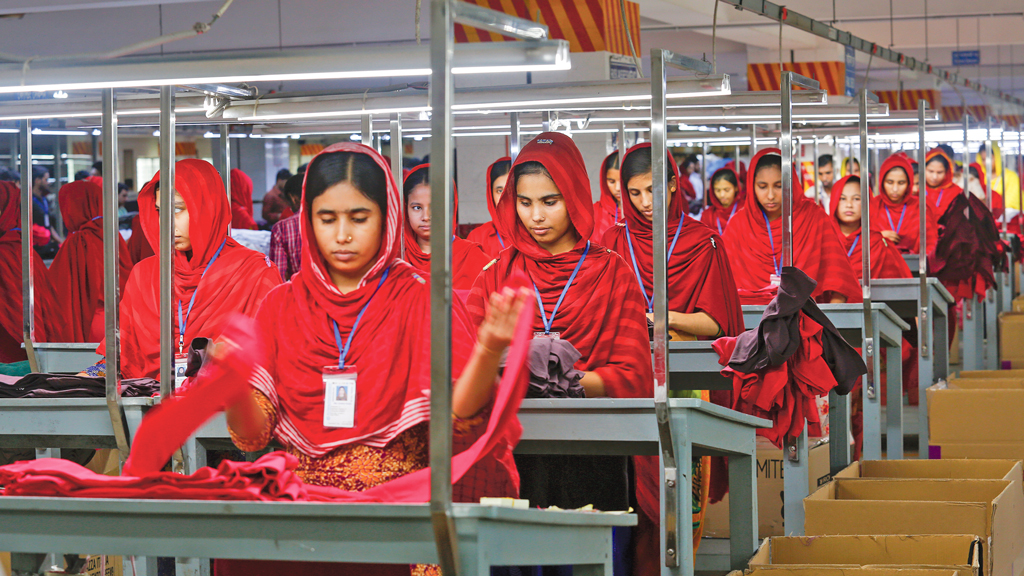
After garment workers proposed a minimum monthly wage of 32,000 taka, factory owners have begun moving on the issue. Many owners have proposed that, instead of only raising wages to cover workers' cost of living, the ration system be strengthened and other benefits, including a fixed house rent allowance, be increased.
Some on the owners' side say that while some factories working with big ready-made garment brands have the capacity to raise wages, medium and small factories do not have the financial strength to absorb the pressure of extra costs. The capacity of all factories, small and large, should be considered in any wage increase.
Last Monday, at the second meeting of the minimum wage board formed to review garment workers' pay, the workers' side proposed a minimum wage of 32,000 taka. The owners' side, however, submitted no proposal that day. They were given four working days, until next Monday, to submit one.
ABM Shamsuddin, a BGMEA director and the owners' representative on the wage board, said preparations are under way to submit the proposal within the set time. On Wednesday afternoon he said, 'The owners' proposal will be submitted by 16 November.'
At the same time he said, 'Worker unrest is being kept alive in factories all around for no reason. Dealing with the instability, the owners cannot focus on the wage increase discussion.' Describing the ongoing worker movement as a major conspiracy against the garment sector, the BGMEA director said, 'There are 70 to 80 worker organizations in the country. Which other sector has so many organizations? What do these organizations do? What do they say, whose money do they run on — does the government look into these?'
Faisal Samad, managing director of Surma Garments and a BGMEA director, also said that even if the minimum wage is calculated considering the cost of living, not all factories in the country have the capacity to pay it. If small establishments are not taken into account, many factories could close because of a wage increase.
However, noting that the owners are actively considering a wage increase, Faisal Samad said yesterday that owners of factories of various levels would gather at the BGMEA building this (Wednesday) afternoon to discuss the matter. A proposal could emerge from that discussion.
Faisal Samad said, 'After a 56 percent wage increase in 2023, annual increments of 9 percent have been given in the last two years. It is doubtful whether any other sector in the country has seen such an amount of wage increase. So instead of raising wages by emotion, we have to come to a calculation. Economists will calculate and show how much workers should get and how much wage-raising capacity the owners have.'
BKMEA president Mohammad Hatem, meanwhile, said the owners will give what is 'logical'. He said workers have demanded the new wage from December, and the owners have also agreed to that. How much the wage should be increased will now be calculated by all the experts together.
Criticizing the proposal to raise the minimum wage to 32,000 taka, the industrialist said, 'In this country, a young graduate now joins a new job at a salary of 18,000 to 20,000 taka. There, 32,000 taka is being demanded in the garment sector.'
Rakibul Alam Chowdhury, a garment entrepreneur from the port city region of Chattogram, said, 'Although wages need to increase, garment buyers do not want to pay higher prices. Many buyers have clearly said they cannot increase garment prices because of a wage increase.'