Bangladesh's first international debt conference opens in Cox's Bazar tomorrow
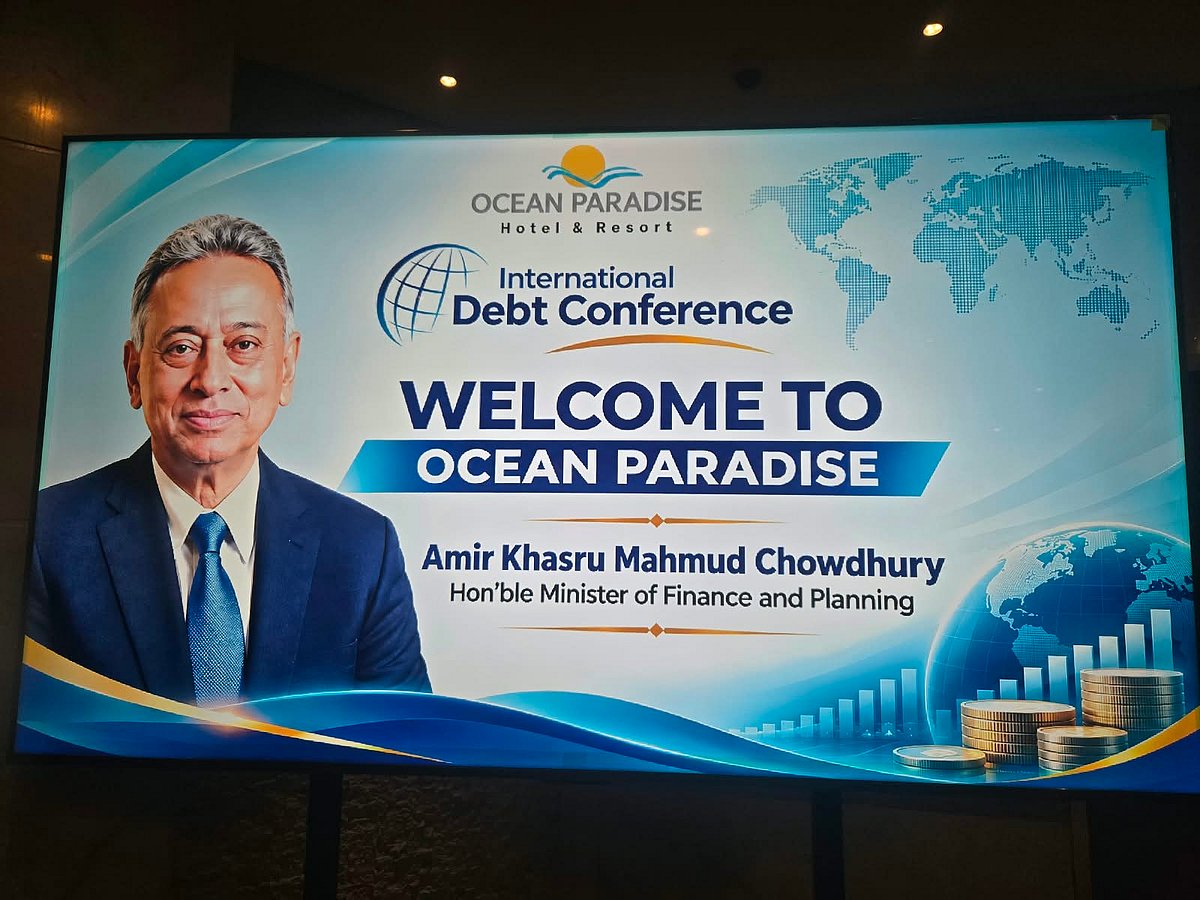
The government has organised the country's first international debt conference, covering reform of public debt management, opening the bond market to foreign investors and strategies for creating new sources of borrowing. The conference will be held in Cox's Bazar tomorrow, 15 and 16 November.
The Finance Division of the Ministry of Finance, with support from the Asian Development Bank (ADB), has organised the event titled 'International Debt Conference Bangladesh 2026'. The two-day conference at the Ocean Paradise Hotel in Cox's Bazar carries the theme 'Public debt management in a changing global context'. Finance Minister Amir Khasru Mahmud Chowdhury is expected to inaugurate it as chief guest.
Seven sessions are scheduled over the two days, covering international experience in public debt management, the global economic situation, borrowing strategies, development of the local bond market and alternative financing.
Officials say Bangladesh's public debt keeps rising, and so does the pressure of interest and debt repayments. In this situation, not only the amount of debt but also its cost, maturity, risk and management efficiency need attention, and these issues will feature prominently at the conference.
A key agenda item is building a separate, effective structure for public debt management, including discussion of establishing a Debt Management Office (DMO).
At present, debt management responsibilities are divided among various government offices and agencies, and borrowing, debt data, risk analysis and repayment planning need more coordinated handling. In many countries, a DMO analyses the overall debt picture, sets borrowing strategy and prepares for future risks.
Increasing foreign investor participation in the local-currency bond market is another major agenda item. Most government borrowing comes from the domestic banking system and savings certificates, while foreign borrowing depends on international development partners. Officials say attracting foreign investment into local-currency government bonds could widen financing sources; market entry and exit, transaction transparency, currency conversion and policy stability are important in this regard.
Creating alternative sources alongside conventional borrowing will also be discussed, including the potential of sukuk and other alternative financing methods. Sukuk is an asset-based Islamic financial investment instrument that the government could use to finance infrastructure and development projects.
Organisers say representatives of various ministries, Bangladesh Bank, the ADB, the World Bank and the International Monetary Fund (IMF) will attend, along with experts from the United States, the United Kingdom, Malaysia, Indonesia, Pakistan and Sri Lanka.
According to the Finance Division, at the end of March 2026 the government's domestic and foreign debt stood at about 22.59 lakh crore taka — 12.95 lakh crore domestic and 9.64 lakh crore foreign. The debt-to-GDP ratio is about 40 percent.
The bigger concern, however, is repayment capacity rather than the amount itself, because Bangladesh's revenue income is comparatively low and a large share of government income goes to interest payments. According to the Finance Division, interest payments on public debt rose 29 percent in the first nine months of fiscal 2025-26 compared with the same period a year earlier.
The World Bank forecasts that Bangladesh's debt-to-GDP ratio could reach about 43 percent in fiscal 2026-27 and 45.2 percent in 2027-28, meaning the debt burden may grow further.