Baihetan in the Jinsha Gorge: A 16,000 MW Underground Plant Supplying Power for 75 Million People
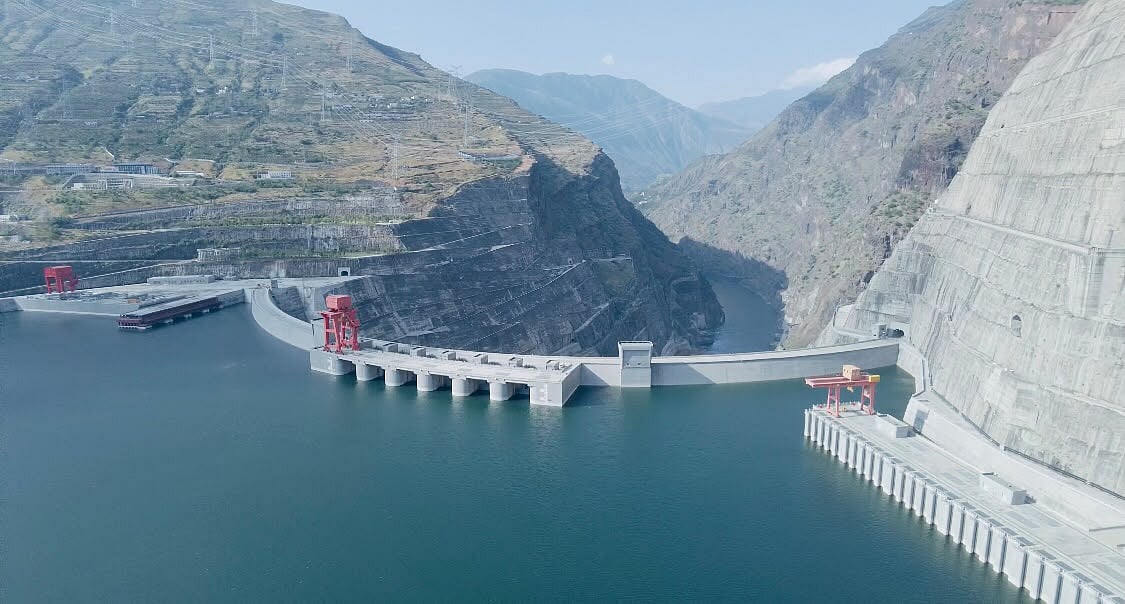
The Baihetan hydropower station has been built inside a steep gorge of China's Jinsha River. Its officials describe it as the world's largest clean-energy corridor. According to them, the plant's electricity can meet the demand of 75 million people.
According to its operators' figures, Baihetan generated more than 250 billion kilowatt-hours of electricity between 2021 and June 2026. The project targets average annual generation of about 62 billion kilowatt-hours.
During a recent visit to the station, Luo Yuanwang, a senior supervisor in its operations division, said it is the world's second-largest hydropower station and that it has met the electricity demand of 75 million people. He said about 400 people currently work on the project and that the station's generating capacity is 16,000 megawatts.
The station is located in Ningnan County of Sichuan Province and Qiaojia County of Yunnan Province. Baihetan is the second of four hydropower projects built on the lower reaches of the Jinsha River; Wudongde comes before it, and Xiluodu and Xiangjiaba after it. Baihetan is about 182 kilometres from the Wudongde station.
The dam's controlled catchment covers 430,300 square kilometres, about 91 percent of the Jinsha River basin upstream of the dam. The reservoir's total capacity is 20 billion cubic metres, of which 10 billion cubic metres is set aside for regulation and storage and 7.5 billion cubic metres for flood control. Alongside power generation, the project is meant to serve flood control, navigation and local economic and social development.
The dam is a concrete double-curvature arch dam whose crest stands 834 metres above sea level. Its main structure has six surface outlets and seven deep outlets for discharging water, and there are three discharge tunnels on the left bank.
The underground powerhouse was built on both banks of the river. Each side houses eight Francis turbine-generator units of 1,000 megawatts each. The project is described as the world's largest underground power station, and the span of its underground caverns is also the largest in the world.
Building the project meant overcoming multiple natural and geological challenges. Temperatures in the project area reach up to 43 degrees Celsius and the maximum wind speed equals force 13 on the Beaufort scale. In the steep mountain terrain, the dam site sits in an asymmetric valley shaped like the letter 'V', which made planning and laying out the structures extremely difficult.
For the first time, a dam foundation was built on columnar-jointed basalt rock. The rock is hard and brittle and contains many cracks; excavation was comparatively easy, but ensuring stability was a major challenge. The project area also faces landslide and mountain-torrent risks, and strict design and safety measures had to be followed with earthquakes in mind.
Chinese officials present Baihetan as a symbol of the effort to produce clean energy at large scale. In their account, large hydropower stations of this kind can supply stable, low-carbon electricity to distant areas with power demand and also help control flooding on the country's major rivers.