Migratory birds flock to Chalan Beel as local youths stand guard
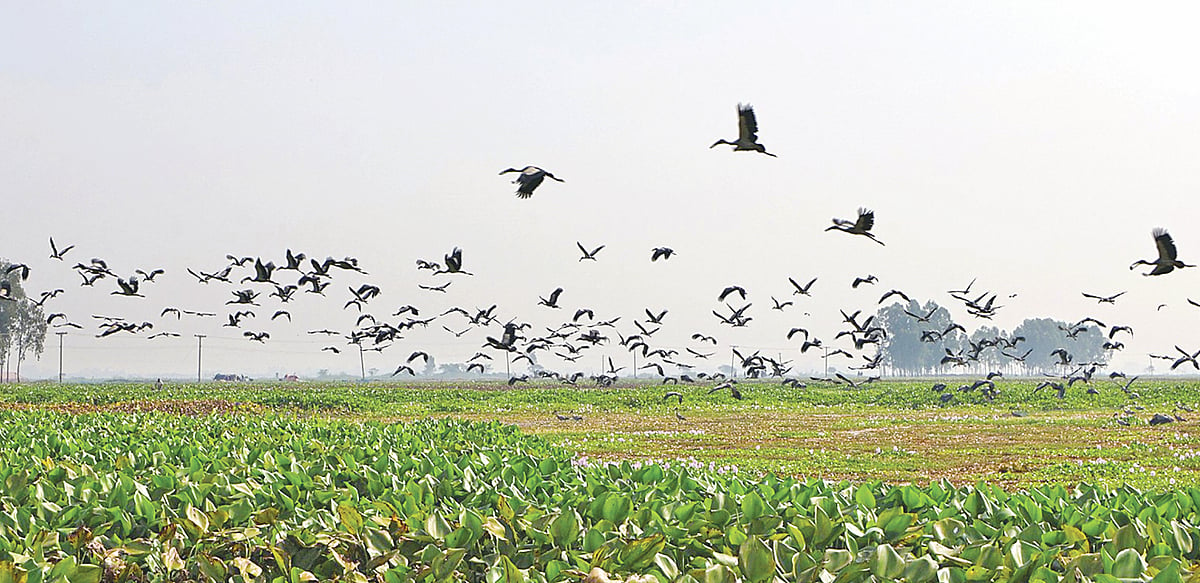
As the monsoon waters recede, thousands of guest birds have gathered at Chalan Beel. White egrets, gulls, balihans ducks, cormorants, openbills and moorhens fill the wetland with calls from dawn, while egrets stand in ankle-deep water catching darikina, punti and batasi fish.
Chalan Beel stretches across Natore, Sirajganj and Pabna districts, with a large part in Natore's Singra and Gurudaspur upazilas. The road from Singra town's Chalan Beel Gate through Baruhas in Sirajganj towards Tarash is known as the 'submerged road' because it goes under water in the monsoon, and guest birds can now be seen flying along both sides of it.
The birds come down to the shallow water at a fixed time every dawn. One species does not fight another over prey—where egrets settle, balihans or cormorants settle elsewhere. At dusk the birds return in flocks to the bushes and tall trees inside the beel.
A tree where egrets roost is not used by other birds, and egrets or moorhens do not roost on the openbills' trees. After returning to their nests the birds chirp for a while before silence falls, and the chirping begins again at dawn.
Local residents and nature lovers from across the country are coming to Chalan Beel to watch the scene, though it is best enjoyed at dawn; as the day advances, the birds scatter.
This safety did not come by itself. Local youths have formed organisations including the 'Chalan Beel Biodiversity Protection Committee', 'Sabuj Bangla' and the 'Chalan Beel Environment Development and Nature Conservation Forum', whose members are spread across the beel keeping watch.
Saiful Islam, general secretary of the Chalan Beel Biodiversity Protection Committee, who has led bird protection for 14 years, said their members range from children to the elderly, and any attempt to kill birds is reported to the organisation's centre immediately.
Saiful Islam said: 'Seeing the birds moving freely in the beel, some people try to hunt them with air guns and traps. We try to stop them. If someone still hunts a bird, we catch him and hand him over to the police, and action is taken under the existing law.'
Residents of the beel's edge, Raju Ahmed and Fazle Rabbi, are also running awareness programmes to protect the birds.