From Kunming via Kyaukphyu to Bangladesh: Which Route Will China's Proposed Corridor Take
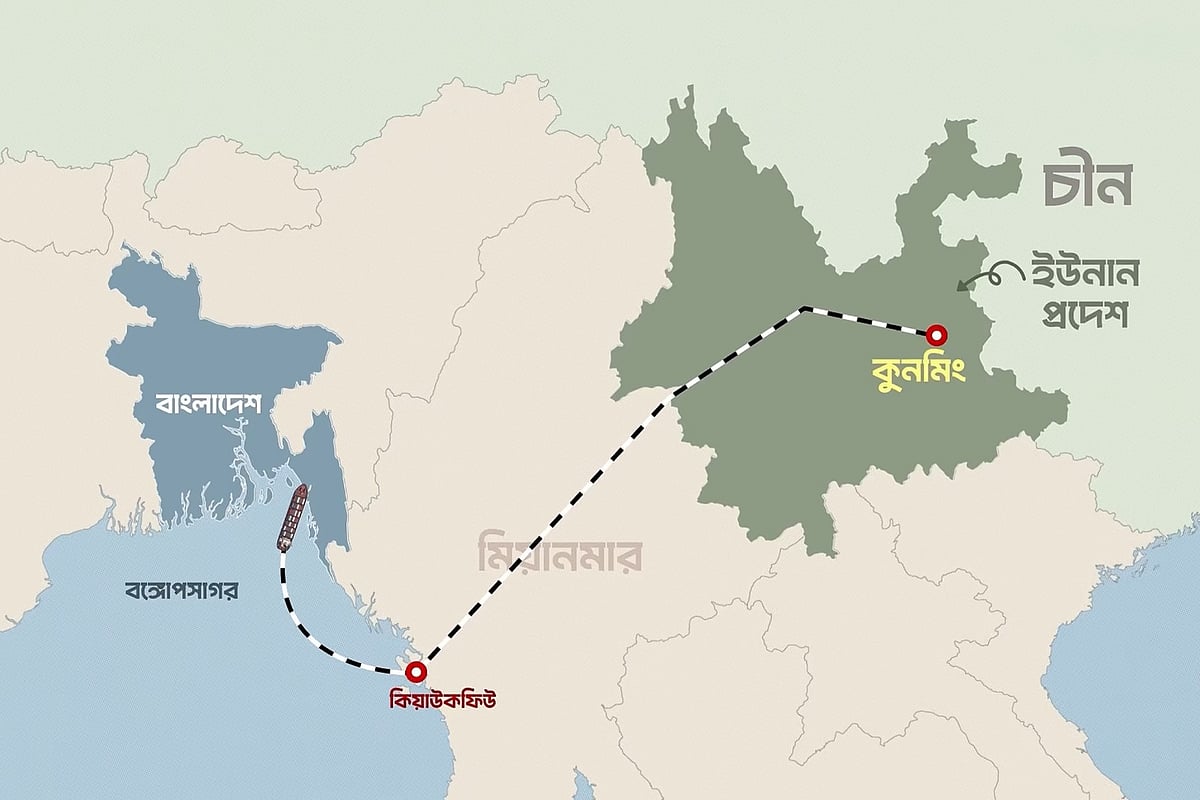
From Kunming, capital of Yunnan province in southwestern China, to Myanmar's coastal Kyaukphyu port, and from that port by sea to Bangladesh — along this route, China has proposed an economic corridor linking Kunming with Bangladesh.
Chinese President Xi Jinping made the proposal for the corridor linking Bangladesh, Myanmar and China at a meeting with Prime Minister Tarique Rahman in Beijing on 26 June. The matter was mentioned in an official statement by China's foreign ministry after the meeting.
China's initial plan is to extend land connectivity from Kunming through Ruili, Muse and Mandalay in Myanmar to Kyaukphyu in Rakhine. Connectivity from Kyaukphyu to Bangladesh would be centred on the sea route.
However, the specific route of this corridor has not yet been fixed. Which route goods will be transported by, which port in Bangladesh will be used, or how land and sea routes will be coordinated — these matters are still at the discussion stage.
Talks with several Bangladeshi diplomats who accompanied Prime Minister Tarique Rahman on the China visit show that, under the initial plan, connectivity from Kunming to Kyaukphyu port would be by land. From that port, small vessels (feeder vessels) would come to Bangladesh via the Bay of Bengal.
Prime Minister Tarique Rahman visited Beijing in late June. Earlier in June, then Foreign Secretary Asad Alam Siam had visited Beijing. Before that, Foreign Minister Khalilur Rahman visited Beijing in May. Chinese officials had given an initial idea of which route China wants for the corridor in discussions with the two of them.
An important aspect of Beijing's latest proposal is that it speaks of building a framework of economic connectivity among the three countries, leaving India out.
The idea of economic connectivity linking Bangladesh, China and Myanmar is not entirely new. It is connected to an older plan for the proposed BCIM economic corridor involving Bangladesh, China, India and Myanmar. That initiative aimed to build a regional connectivity system from Kunming through Myanmar and Bangladesh to Kolkata in India.
Formal talks among the four countries on BCIM began in 2013. The same year, representatives of the four countries met in Kunming. In 2014, discussion of the initiative also advanced in Bangladesh. But because of the deterioration in Beijing–New Delhi relations over a border dispute and India's objection to China's Belt and Road Initiative (BRI), BCIM ultimately did not see the light of day.
The BCIM initiative was not dropped entirely. In July 2024, the then prime minister of Bangladesh visited China. The joint statement of the two countries on that visit recognised the importance of BCIM. In March 2025, regional connectivity and the BRI were discussed during the China visit of the then interim government's chief adviser, Professor Muhammad Yunus.
Kyaukphyu is an important place for China. Work is under way there to build a Chinese deep-sea port and a special economic zone. The existing China–Myanmar oil and gas pipeline is also linked to Kyaukphyu port. China has now brought forward the possibility of linking Bangladesh to this network.
China initially wants to move forward with building a transport system by sea from Kyaukphyu to a port in Bangladesh. But no final decision has yet been made on which Bangladeshi port will be used, how frequently ships will sail, or how much cargo will be transported. The economic feasibility of the system is also not clear.
Two matters need to be seen separately here. One is making the land-based connectivity from Kunming to Kyaukphyu fully operational. The other is bringing goods to and from Bangladesh by sea from Kyaukphyu. The future of the second depends much more on Myanmar's political and security situation. The ongoing conflict in Rakhine State and the Arakan Army's capture of most places there raise questions over the future of China–Myanmar–Bangladesh connectivity.