Women Provide 58 Percent of Farm Labour Yet Face Loan and Market Barriers, Roundtable Speakers Say
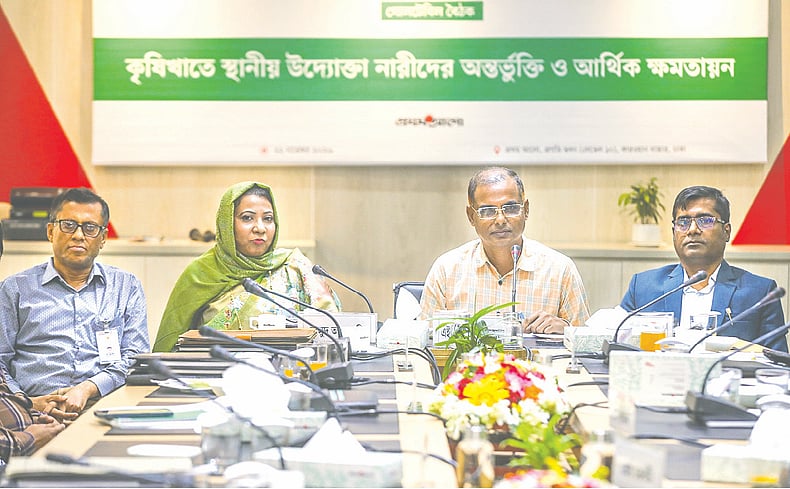
Women's participation in agriculture is higher than men's, yet that labour still has not received recognition, speakers said at a roundtable titled 'Inclusion and financial empowerment of local women entrepreneurs in the agriculture sector'. They said women entrepreneurs face social and institutional barriers, and that removing them requires institutional support, easing market barriers and making loans easier to obtain. The roundtable was organised by the non-governmental development organisation Welthungerhilfe.
At the start of the discussion, freelance consultant Shoaib Shazzad Khan presented a paper on the kinds of barriers women agricultural entrepreneurs face.
HM Moniruzzaman, deputy director (extension) of the Department of Agricultural Extension, said women account for 58 percent of total labour in agriculture, which puts the number of women farmers at around 17 million. He said that beyond the fields, women's role is greatest in growing vegetables on homesteads, raising livestock and farming fish. In his view, policy support for women in agricultural planning must increase, loans for women should be made easier, if necessary through agreements with banks, and the agricultural policy framework should be built giving women priority. He said the Department of Agricultural Extension is working to create women entrepreneurs.
Hossain Md Selim, a deputy director of the Department of Livestock Services, said women's role in Bangladesh's livestock sector and rural economy is extremely important. According to figures he gave, more than 60 percent of small livestock farms in the country are run by women and 40 percent of those directly involved in the poultry sector are women. He said women are being given priority in government policy and in the livestock department's development projects, and that women make up 60 to 90 percent of participants in farm management training. He stressed digital marketing to connect women agricultural entrepreneurs with the market.
Masud Ara Momi, deputy director (planning) of the Department of Fisheries, said 80 percent of workers in fish export processing plants are women and women's participation in dried fish production is 80 to 85 percent. She said modern technology must be made accessible to women in these sectors, and alternative ways must be found to connect women who cannot join the marketing system with their produce to the market.
Samir Mallik, deputy director (child protection) of the Department of Social Services, said that unless a woman's financial capacity grows, she is not given importance when family decisions are made. He said banks do not want to lend when a woman has no land or pond in her name, but the Department of Social Services is giving women loans without collateral. He also said there should be coordination among government and private organisations to smooth the path for women agricultural entrepreneurs.
Shirin Sultana, partnership adviser of UNOPS Bangladesh, urged initiatives to preserve products produced by women. She said women's access to smart agriculture must be ensured and cold storage must be built to protect women's produce, so that a woman producer is not harmed if her goods remain unsold.
Shreya Chakraborty, country focal point of the International Water Management Institute, said there is no complete picture or data on how much women's labour there is in each sector. Malte Sumenfed, head of programmes at Welthungerhilfe, called for identifying the systemic challenges women agricultural entrepreneurs face and for strengthening cooperation between government and private development organisations to remove them.