US, China and Russia in a three-way race for Africa's mineral wealth
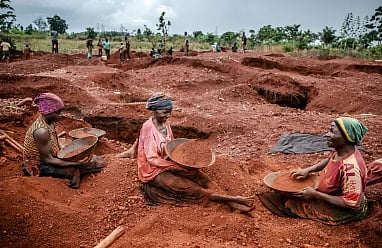
The cobalt mines of the Democratic Republic of Congo, the lithium reserves of Mali and the uranium deposits of Niger — the vast mineral wealth spread across African countries is drawing an increasingly intense competition among the United States, China and Russia.
China dominates the global supply chains of several critical minerals. Russia, meanwhile, is expanding its influence in Africa through military and security cooperation, with Moscow's presence growing especially in the Sahel countries. The United States is moving toward Africa's mineral resources through diplomacy, investment and infrastructure development.
The contest is not limited to taking control of mines or extracting minerals. Ports, railways and trade corridors used to transport the minerals are also part of the struggle for influence.
Africa holds huge reserves of cobalt, lithium, copper and uranium. These minerals are vital for electric vehicles, renewable energy, modern technology products and the defence industry. Securing control of them has become a strategic priority, especially for the United States, because Washington wants to reduce its dependence on China for these resources.
To that end, US President Donald Trump announced a programme called 'Project Vault' last February. The $12 billion initiative aims to build a strategic stockpile of critical minerals for American industry.
China, on the other hand, has been investing for many years in Africa's mining sector, in the industries that process minerals, and in related infrastructure. According to data from China's customs department, trade between China and Africa reached a record $348 billion last year, further consolidating Beijing's position as Africa's largest trading partner.
Compared with China and the United States, Russia's economic presence in Africa is relatively small. Instead of an economic footprint, Moscow mainly uses military cooperation and security partnerships as its tools of influence. In 2023, the 'Africa Corps' was formed under Russia's defence ministry; the force oversees most of the activities in Africa of the Wagner Group, Russia's mercenary organisation. A 2024 study by RAND Europe, commissioned by the UK Foreign Office, identified gold as an important reason for Russia's activities in Africa.
The Democratic Republic of Congo (DRC) sits at the centre of the competition for Africa's minerals. The country produces more cobalt than any other in the world. According to the US Geological Survey (USGS), about 73 percent of the cobalt mined worldwide in 2025 came from Congo. China holds a strong position in Congo's mining sector, with Chinese companies owning or holding stakes in several of the country's large copper and cobalt mines. China also dominates the world's cobalt refining industry.
Last December, the United States and Congo signed a strategic partnership agreement aimed at increasing US access to critical minerals and encouraging investment in mineral-related infrastructure and processing. Under the deal, the Congolese government will identify strategically important mines and exploration areas, after which investors from the United States and 'eligible' partner countries will get priority opportunities to bid on those projects. This month, however, Congo's finance minister Daniel Mukoko Samba urged the United States to turn the agreement's promises into actual investment. In his words, the partnership's success should not be judged by how many agreements are signed, but by how many projects are implemented. The Congolese government does not want only to increase raw material exports; it is seeking investment in mineral processing, electricity supply and overall economic development.
The supply system that carries minerals from Africa to international markets is also part of the competition. Through its Belt and Road Initiative (BRI), China has invested heavily in African infrastructure, and several dozen African countries have signed cooperation agreements with Beijing under the initiative. On the other side, the United States and its European and African allies are backing a project called the 'Lobito Corridor'. The transport network will link Angola's Atlantic coast with Congo's copper- and cobalt-rich region, and there are plans to extend the railway to Zambia in the future. The project aims to create a fast and effective route for mineral exports and to increase regional trade.
Mali and Niger, in Africa's Sahel region, hold vast reserves of lithium, gold and uranium. But political instability and the activities of armed groups are the main obstacles to foreign investment in the sector. After military coups and deteriorating relations with Western countries, Mali and Niger strengthened security cooperation with Moscow; neighbouring Burkina Faso followed the same path. Russia has deployed members of the Africa Corps in the region.
The United States is now also trying to rebuild relations in the Sahel. Last February, senior US State Department official Nick Checker visited Mali; through the visit Washington showed interest in starting relations with the country afresh and conveyed US respect for Mali's sovereignty. According to the US Geological Survey, Mali produced about 9,400 tonnes of lithium last year, making it one of Africa's leading lithium producers. China has interests in Mali's Goulamina lithium mine. Meanwhile, a subsidiary of Russia's state nuclear agency Rosatom received a licence two years ago to explore the country's Bougoula lithium project.
Washington is also trying to rebuild economic ties with neighbouring Niger. After US troops withdrew from the country in 2024, the uranium sector has become an important area of this effort. In September this year, the US International Development Finance Corporation (DFC) approved financing of up to $414 million for Niger's Dasa uranium project, which is being implemented by the Canadian mining company Global Atomic. Several conditions must be met to receive the financing, however, an important one being the creation of an effective route to transport uranium out of Niger, since the country has no direct access to the sea.
The competition among the United States, China and Russia over Africa's minerals has created new opportunities for the continent's countries — African governments now have the chance to attract more foreign investment, build economic relations with multiple countries and bargain for better terms over their mineral resources. But the risks are no smaller. If control of mining and mineral processing stays in the hands of foreign companies, African countries will be left doing nothing more than exporting raw materials. Added to that are problems of insecurity, corruption and weak infrastructure.