Residents urged to evacuate before nearly five tons of explosives are detonated in Iowa
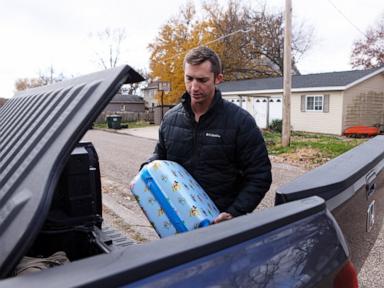
Federal officials have recommended that residents near the Iowa Army Ammunition Plant in Middletown, Iowa — especially children and pregnant women — evacuate before the U.S. Army carries out a controlled detonation of nearly five tons of lead azide scheduled for Wednesday.
Adam Telle, the acting secretary of the Army, told a news conference that his teams worked with several experts to mitigate the effects of detonating nearly 9,700 pounds of the toxic and volatile substance, including using a waterwall, foam barriers and gel blocks to contain the explosion.
Maj. Gen. Eric Shirley, commanding general of the U.S. Army Sustainment Command, told reporters that after months of research there was no other way to safely dispose of the barrels stored at the Middletown facility. 'Inaction is no longer an option,' he said.
Officials said the explosion is scheduled for 9 a.m. local time. Nearby Middletown residents have been advised to leave their homes on Tuesday and remain away until Friday at the earliest. Evacuated residents will be notified by phone once the all-clear is given and may then return home at their convenience, the Army said in an advisory posted Tuesday.
The Army said the recommended evacuation zone covers a five-mile cone extending southwest of the plant and one mile beyond the dispersion path.
Cam Hamilton, administrator of the Federal Emergency Management Agency (FEMA), said at the news conference that people in the southwesterly area who choose to relocate will be offered services, including transportation as well as relocation, food and nourishment for those who move out of an abundance of caution.
Sean Kaufman, the principal deputy assistant secretary for preparedness and response at the U.S. Department of Health and Human Services, told reporters that pregnant women, children and anyone with a chronic illness living near the plant should evacuate. Those outside the area who feel uncomfortable should do what they need to do to take care of their families, he said.
Missouri Governor Mike Kehoe activated the State Emergency Operation Center on Tuesday in anticipation of the blast. In a statement he said it was a proactive measure to ensure all resources are available if necessary, and that state agencies would continue to take the actions needed to protect the health and safety of citizens and livestock.
The planned explosion was originally scheduled for last week but was postponed twice because of weather conditions and a lawsuit. Lead azide is the primary explosive used to detonate munitions such as grenades and artillery shells.
The Iowa Environmental Council and the Sierra Club's Iowa Chapter filed an emergency motion on Thursday arguing that the detonation could spread lead dust across a large area, potentially reaching communities more than 100 miles from the plant.
In an order filed late Thursday night, the Eighth Circuit Court of Appeals granted an administrative stay of the permit. On Monday the court lifted the stay and denied the emergency motion. The two environmental groups said they would not pursue further legal action after Monday's decision, but urged the federal government to remain transparent with the public about the explosion.
Col. Aaron Teller, group commander of the 71st Explosive Ordnance Disposal group, told reporters the lead azide could not be chemically treated because the barrels have deteriorated rapidly over the past eight months. Crystallized lead azide has accumulated on the exterior of the barrels and on the lids, preventing the barrels from being moved or the lids removed, he explained.
Tom Croci, associate administrator for national security and operations coordination at the Environmental Protection Agency, said the agency will monitor lead levels in the area for as long as it takes to be comfortable that levels are back to safe levels. Information gathered in the field in real time will be consolidated and released publicly, he said.
NASA also announced on Tuesday that it has sent several research planes and scientific equipment to help the federal government monitor conditions at the plant. The agency has sent three aircraft and is also using data from TEMPO, a satellite instrument that monitors pollution and other atmospheric conditions.