After an eight-year journey, Europe and Japan's BepiColombo enters orbit around Mercury
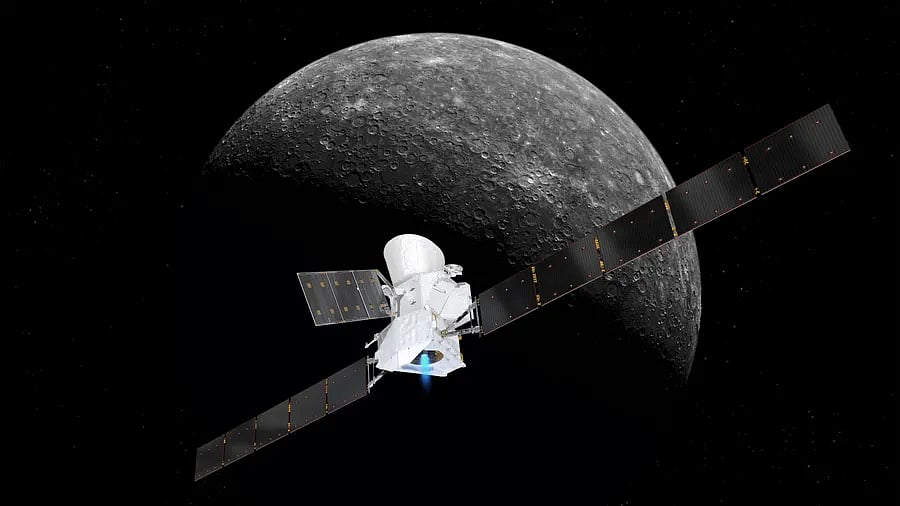
After a long eight-year journey, the joint European-Japanese spacecraft BepiColombo has successfully entered orbit around Mercury. The craft, which left Earth in 2018, swung past several planets to slow itself down before recently entering Mercury's orbit. After NASA's Messenger mission, it is only the second spacecraft in history to orbit Mercury.
Reaching Mercury, the planet closest to the Sun, is no easy task. Because it sits so close to the star, the Sun's powerful gravity pulls any spacecraft towards it at tremendous speed, making it extremely difficult to slow down and enter the small planet's orbit. It takes more energy to reach Mercury's orbit than to travel to Pluto, the dwarf planet at the far edge of the solar system.
BepiColombo is made up of two separate orbiters. Within the next 18 days, the craft will separate into two parts. Built with special armour to withstand the Sun's intense heat, the two orbiters will analyse everything from the outer boundary of Mercury's magnetic field to the planet's huge iron core.
According to Geraint Jones, project scientist at the European Space Agency, Mercury is the rocky planet about which we know the least. The mission's data will not only tell the history of the solar system's birth, but also give new insight into planets around distant stars, because many exoplanets discovered so far sit very close to their stars, just like Mercury.
Although it can be seen with the naked eye, Mercury is quite difficult to observe from Earth. In the 1970s, NASA's Mariner 10 flew past Mercury three times, and from 2011 to 2015 Messenger collected data from the planet's orbit for the first time. The new mission will build on those earlier discoveries.
The mission is named after the Italian scientist Giuseppe Colombo, who was known as 'Bepi'. It was Colombo who calculated the trajectory of the Mariner 10 mission.
On Earth, storms, rain and tectonic plate movement erase ancient geological marks, but that does not happen on Mercury; the planet has almost no atmosphere and no active tectonic plates. So the scars and craters accumulated over billions of years lie arranged on Mercury's surface like a history book.
Mercury is shrinking inward as it cools. As a result, its outer layer has wrinkled, creating thousands of huge steep cliffs nearly two miles high. The European orbiter will make a precise map of the whole planet so scientists can understand exactly how it is shrinking. Ancient lava plains and marks left by volcanic eruptions will also be examined.