Gaffar started orange farming after watching YouTube; Satkhira orchard yields up to one and a half maunds per tree
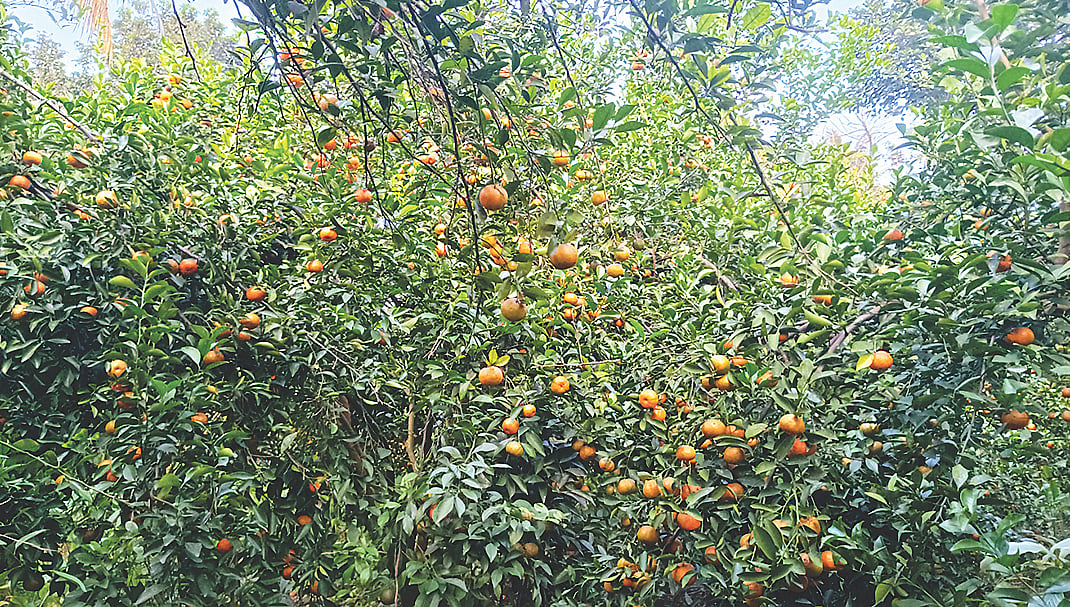
In Ilishpur village of Keralkata union in Kalaroa upazila of Satkhira, farmer Abdul Gaffar's orchard is busy with the orange harvest. Oranges are being cut from the trees with scissors by their stems and placed in bamboo baskets; when a basket fills, the fruit is poured onto a tarpaulin spread inside the orchard.
This is not a hill orchard but a plains orchard of about two and a half bighas. Visiting at noon on 25 November, 144 orange trees of the China-3 variety were seen bearing fruit. Some trees, seven to eight years old, have produced between one and one and a half maunds of oranges each.
The orchard's oranges are sold in local markets and also go to Dhaka. Beside the road in Kalaroa upazila town, local resident Md Sumon Mia was selling oranges at Tk 160 per kilogram. He said, 'These are our Kalaroa oranges. They are quite sweet to eat.' He had bought the oranges from a local grower's three-bigha orchard.
According to Sumon Mia, several farmers in nearby Deyara, Khordo and Salimpur are also growing oranges, and oranges can be sold for about three months in the season.
Gaffar once lived abroad. After returning home he traded in electrical goods for eight to nine years. Around 2018, watching a YouTube video on China-3 orange cultivation in his spare time sparked his interest. He then visited an orchard in another district, tasted the oranges, and examined the soil and weather before deciding to grow them.
Gaffar said, 'I thought then that if this orange could be grown elsewhere in the country, it could be grown in my area too.' During Ramadan in the Covid period, he travelled about 100 kilometres by motorcycle to Chuadanga and brought back around 200 grafted saplings. Some saplings died, and a few trees later had to be cut because of building construction on the land and shade from large trees. The trees began bearing fruit three years after planting.
Farm worker Md Golam Azam was harvesting oranges in the orchard. He said, 'Last year the orchard had no fence. People used to pick oranges from the trees and take them away. So no account could be kept of how much was produced and sold. This year a wire fence has been put up. I and another worker have been kept to look after the orchard.'
Gaffar said fertiliser, pesticide and care cost about Tk 40,000 a year. In addition, each of the two workers is paid six to seven thousand taka a month. He is currently selling oranges from the orchard at Tk 137 per kilogram; wholesalers buy from the orchard and take them to Dhaka. In the retail market, oranges sell at Tk 160 to 200 per kilogram. He hopes to sell four to five lakh taka worth of oranges this season.
On taste, Gaffar said, 'The oranges from my orchard are not only sweet, they have a slight tartness too. I also pay attention to the fruit's colour, size and cleanliness, because buyers like good-looking fruit alongside the taste.'
According to the Satkhira district Department of Agricultural Extension, 65 farmers in the district are currently growing oranges. The cultivated area is 10 hectares, the same as last year. At an average yield of 11 metric tonnes per hectare, the district produces about 110 metric tonnes of oranges a year.
Iqbal Ahmed, deputy director of the district Department of Agricultural Extension, said income from orange sales per bigha is Tk 176,040 and production cost Tk 55,000, giving a possible profit of Tk 121,040 per bigha.
Visiting the orchard, Kalaroa upazila sub-assistant agriculture officer Mrinal Kanti Mondal said the China-3 and Mandarin varieties are suitable for this region. Satkhira's comparatively warm and humid weather gives it potential for orange cultivation, and orange growing began in the district eight to nine years ago. In his view, higher production could reduce dependence on imported oranges. But he advised growers not to start cultivation merely by watching YouTube videos; they should first learn about soil, weather, variety and method and proceed with the agriculture department's advice.
Gaffar wants to expand the orchard further. About two months ago he planted new saplings on another one and a half bighas beside the old orchard. He hopes that with regular care the new orchard will also yield well.