A 'lemon empire' in six Fulbaria villages: Tk 25–30 lakh of lemons sold at the daily market
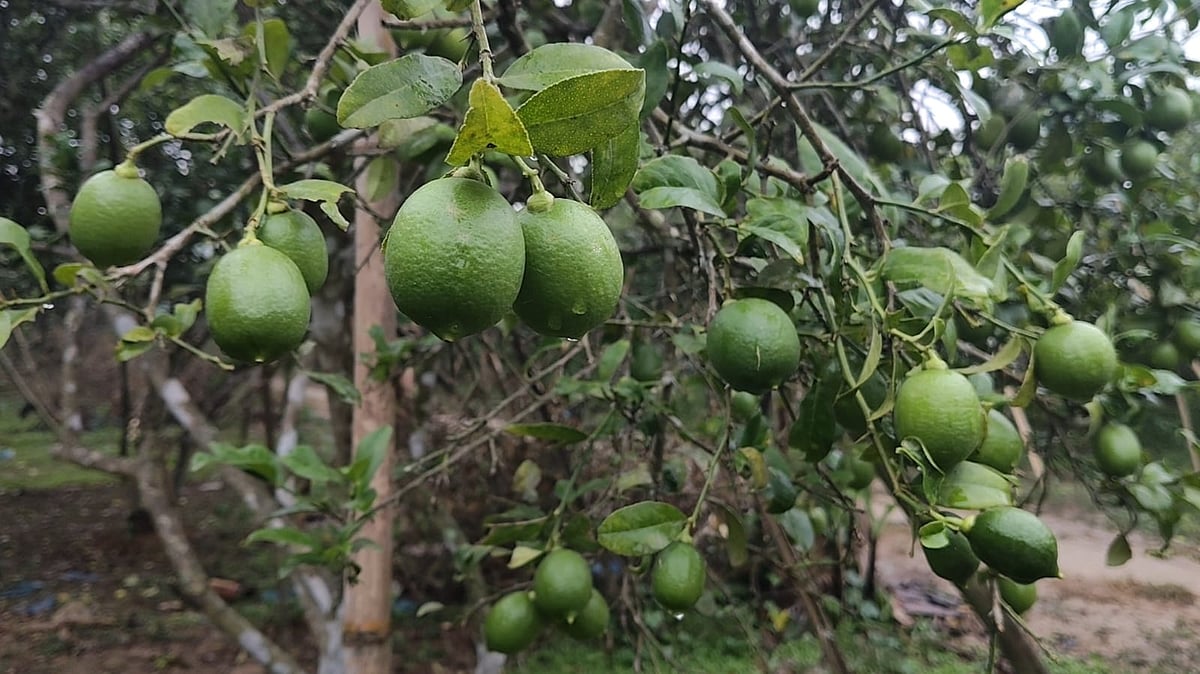
Wherever the eye turns in Enayetpur Union of Fulbaria upazila, Mymensingh, there are lemon trees — from house yards to vast open fields. Over roughly the past decade and a half, the lemon has become the area's main cash crop. A lemon market sits in the area every day, drawing wholesalers from districts across the country.
The cultivation has spread across six villages of Enayetpur Union — Enayetpur, Gopinathpur, Soaitpur, Betbari, Kahalgaon and Dolma — about 18 kilometres south of the Fulbaria upazila town, near the border. The area is known locally as a 'lemon empire'. Between 2,500 and 3,000 farmers are involved in lemon farming directly or indirectly, and local farmers claim lemon orchards cover nearly 90 percent of the union's land.
A recent visit found lemon orchards stretching field after field around homes — Colombo lemons in some places, seedless varieties in others. Lemons picked from the orchards are packed into sacks and taken to Enayetpur market, where farmers haggle with wholesalers.
Enayetpur market hosts one of the country's biggest lemon markets. Trading runs beside the road in front of the Enayetpur Union Parishad from noon to evening every day. Wholesalers come from Dhaka, Chattogram, Barishal, Khulna, Pabna, Sirajganj and other districts.
By farmers' and wholesalers' estimates, lemons worth an average of Tk 25 to 30 lakh are sold at the market each day. A sack of Colombo lemons (40 kg) sells for Tk 2,500 to 2,800, a sack of seedless for Tk 1,400 to 1,700, and a sack of Kagzi lemons for Tk 4,500 to 5,000.
Dhaka wholesaler Abu Hanifa comes to the market two or three times a week and buys 120 to 150 sacks of lemons. He says supply in the market is low at the moment while demand is high, which is why prices are comparatively higher.
Local man Daulat Ali has leased the Enayetpur market for one year for Tk 1 crore 4 lakh. He says 2,000 to 2,500 sacks of lemons change hands at the market every day. During Ramadan, a sack can sell for Tk 5,000 to 12,000. A toll of Tk 20 per sack is currently collected.
Farmer Masud Talukdar of Soaitpur village planted seedless and Colombo lemons on six acres three years ago. He sold about Tk 20 lakh of lemons last season and hopes for Tk 30 lakh this season if prices hold. He says a few farmers began commercial lemon farming about a decade and a half ago; now the lemon is the union farmers' main cash crop.
Mokbul Hossain of the same village grows Colombo lemons on 32 katha of land. He has sold Tk 2 lakh of lemons so far and hopes to sell Tk 5 lakh more in the rest of the season. Md Rabbani works as a labourer in a Soaitpur lemon orchard — picking lemons, preparing land, tending trees, applying fertiliser and watering keep him busy all year. He works from 8:30 in the morning to 4 in the afternoon for a daily wage of Tk 600, which runs his household.
According to the Fulbaria upazila agriculture office, lemons have been cultivated on 754.8 hectares in Fulbaria this year — 453 hectares of Colombo, 283 of seedless, 15 of Kagzi and 3.8 hectares of the Zara variety. Enayetpur Union alone has about 550 hectares of lemon orchards.
The agriculture department estimates the Colombo crop could be worth about Tk 63.42 crore and the seedless crop about Tk 31.13 crore. Adding the market value of the Kagzi and Zara varieties, total sales this season could reach about Tk 95 crore — and could pass Tk 100 crore in a year if the market stays favourable.
In the 2018–19 fiscal year, exporters shipped 200 to 250 tons of lemons from this area to the Middle East, and farmers profited selling at about Tk 100 per kilogram. But the exports could not be sustained. Md Abu Raihan, Fulbaria's acting sub-assistant plant protection officer, says exporters give priority to Sylhet lemons because of their larger size. Enayetpur farmers also have no transport of their own and no quality crates or cartons; lemons sent to Dhaka in sacks were marked and scratched, and about 50 percent were rejected on arrival.
Under an agriculture department project, demonstration cultivation of the Zara variety began in Enayetpur in mid-2023. A mature orchard could yield 10 to 15 metric tons per hectare a year. But there is no demand for it in the local market and wholesalers are not interested in buying it. Although it could sell for about Tk 70 per kilogram in Dhaka or Sylhet, farmers cannot send it there because of transport costs and a lack of buyers, and they fear losses.
Enayetpur has no modern lemon packaging or storage facilities, no refrigerated transport and no way to grade export-quality lemons. Farmers say a modern packaging centre, storage and transport would cut waste, let them send lemons directly to big cities and abroad, and secure fair prices. Fulbaria upazila agriculture officer Sukanta Dhar says exports cannot be implemented by the upazila agriculture department alone, as many issues are involved; the deputy commissioner and higher authorities have been informed, and the Department of Agricultural Marketing is working on marketing. Recently, a team of two professors from Bangladesh Agricultural University and a representative of the UN Food and Agriculture Organization (FAO) visited the area and will provide an action plan on export potential and what needs to be done.