Aman cultivation exceeds target in Manikganj, farmers still doubtful about profit despite good yield
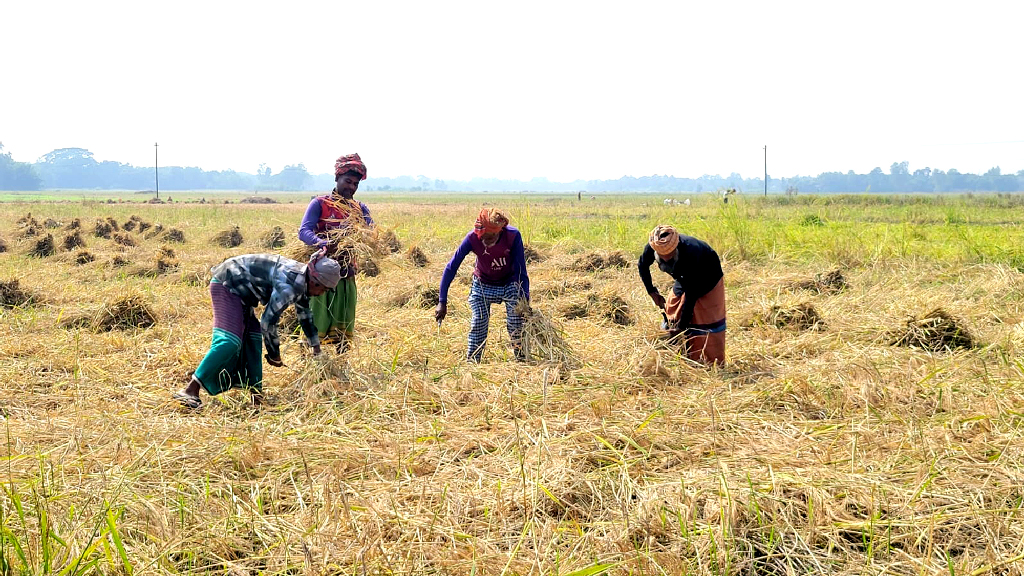
Manikganj's fields are now full of golden paddy. Ripe paddy is being harvested in some places and threshed in others, and the new crop is reaching farmers' homes. Thanks to favourable weather and farmers' hard work, Aman cultivation in the district has exceeded its target this season. But farmers say that despite the good yield, there is no certainty of the desired profit under the pressure of labour wages, production costs and market prices.
According to the Department of Agricultural Extension, the target for transplanted Aman cultivation in the district's seven upazilas this season was 13,300 hectares. Against that, cultivation has taken place on 15,897 hectares — 2,597 hectares more than the target. By 26 November, paddy had been harvested from 10,015 hectares, meaning about 63 percent of the cultivated land has been harvested. The production target for this season has been set at 50,871 tonnes.
A special picture has been seen in the district's Aman cultivation in Harirampur upazila. Alongside transplanted Aman, broadcast Aman has also been cultivated in a notable amount here. Last season, the two types of Aman together were cultivated on 2,400 hectares. This time the target was 2,600 hectares. Against that, cultivation has taken place on 3,300 hectares, of which broadcast Aman is 3,250 hectares and transplanted Aman 50 hectares. Aman cultivation in the upazila has risen by 900 hectares in one year.
But there is doubt over whether farmers' income is rising along with cultivation and yield. Motahar, a farmer of Charpara village in Gopinathpur union of Harirampur, said that although the cultivation cost of broadcast Aman is comparatively low, a large amount of money has to be spent on labour at the time of harvesting and threshing the paddy. On the other hand, the market price of paddy is not as expected either. So despite the good yield, he is worried about how much will remain in hand after all the costs.
Khandaker Mizanur Rahman, a farmer of Shikdarpara village in Balla union of the same upazila, has cultivated Aman on six bighas of land. By his calculation, a good yield could give eight to nine maunds of paddy per bigha; if the yield is lower, it could fall to five or six maunds. At the current market price, selling the paddy from each bigha could bring eight to nine thousand taka. Of that, about six thousand taka is spent on harvesting and labour alone. So after deducting just this cost, two to three thousand taka remains. There are other cultivation costs besides. Some extra money can be earned if the straw can be sold. Overall, he said, it is difficult to get the desired profit despite the good yield.
Ratan Dewan, a farmer of Ubhajani village in Ghior upazila, has cultivated Aman on five bighas of land this time. He hopes to get about 40 maunds of paddy from the land. Although hopeful about the yield, he said the amount of profit will ultimately be determined by matching the market price of paddy and the labour cost.
Meanwhile, a demonstration plot of BRRI Dhan-103 in Daulatpur upazila has shown a good yield. The 20-square-metre plot produced 12.61 kilograms of paddy. By calculation, that is equivalent to a yield of 6.305 tonnes per hectare. However, this is the yield of a demonstration plot; it cannot be treated as the average for the district's overall production.
Harirampur upazila agriculture officer Md Touhiduzzaman Khan said the Aman yield has been good this time as the weather was favourable. High-yielding seed and fertiliser were distributed among farmers, alongside necessary advice. Favourable weather and farmers' care played a role in raising the yield.
District Department of Agricultural Extension deputy director Mohammad Shahjahan Siraj said transplanted Aman cultivation has exceeded the target in all seven upazilas of the district. Production is also expected to rise this time as the weather was favourable.
At one time, the Nabanna festival would begin in rural Bengal around bringing the new paddy home. Villages would come alive with new rice, pitha-puli, relatives visiting and folk arrangements. With the change of time, that festival's arrangements and social elements have faded a great deal. Paddy still ripens in the fields and the new crop still reaches the granary; but although the production statistics paint a picture of prosperity, the farmers' income-and-expenditure accounts tell a different story.