Waste mountain 50-70 feet high rises on the Bankkhali at Cox's Bazar's Kasturaghat, court order to remove it unimplemented
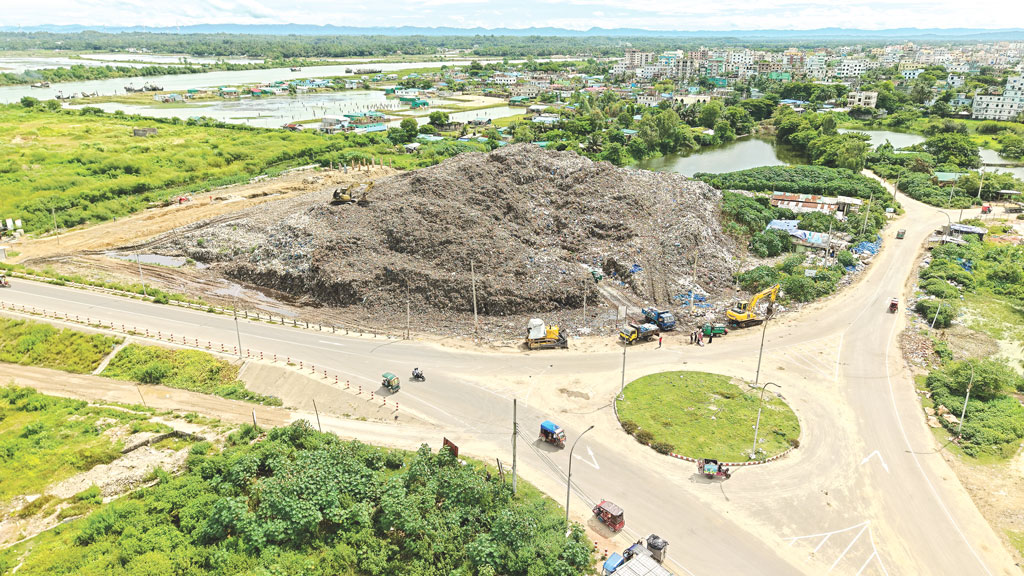
Kasturaghat on the Bankkhali river in Cox's Bazar sits close to the deputy commissioner's office, the municipality office and the Sadar police station. From this ghat on the western side of the town, the Bankkhali flows through Nuniyarchhara into the Bay of Bengal.
Once one of the busiest points for boat transport, the ghat has largely been lost to encroachment and pollution. A char that rose at the ghat is now a dumping ground, and the town's waste piling up there has turned into a huge mountain. Residents nearby are struggling to live with the stench from the dump.
A High Court verdict exists to remove the waste mountain and stop the encroachment and pollution, but it has not been implemented. Instead, the Cox's Bazar municipality itself brings the town's daily waste by truck and dumps it at Kasturaghat. Polluted water draining from the pile mixes into the river, polluting the river water as well.
According to the municipality's own figures, the town produces 164 tonnes of waste every day. Only 10 tonnes of it is taken to the designated dumping station at Mithachhari in Ramu. A large part of the rest is dumped at Kasturaghat.
It is not only Kasturaghat. In Kalatoli, Sugandha and Laboni areas of Cox's Bazar, the country's main tourist town, waste also lies scattered in drains. That waste reaches the sea through drains, canals and the river, increasing marine pollution and threatening biodiversity.
A recent visit found a regional road entering the town right beside the dump. Two more paved roads link it to the town to the south-east. A bridge over the river next to the dump, opened three years ago, draws visitors, and many people pass by the dump holding their noses.
Years of piling waste has given the dump the shape of a hill. Some parts are 50 to 70 feet high. Excavators were seen levelling the waste mountain there.
Residents of Anderson Road, Badarmokam and Peshkar Para beside the Kasturaghat waste mountain, along with people at local businesses, are fed up with the stench. Senior journalist Tofail Ahmed lives on Anderson Road, 50-60 metres from the dump. He said keeping the doors and windows of his house shut does not save them from the smell.
Omar Ali, caretaker of Faisal Tower in Badarmokam, said the smell grows sharper in winter when the wind blows from the north, and people across two to three kilometres around are suffering from it.
Karim Ullah Kalim, general secretary of the Cox's Bazar unit of the Bangladesh Poribesh Andolon (BAPA), said it is deeply unfortunate that a huge waste mountain has grown in the country's main tourist centre. The waste is devastating the environment and public health, and the toxic liquid draining from it is mixing into the soil and groundwater, threatening biodiversity, he said.
Abu Morshed Chowdhury Khoka, president of Cox's Bazar Civil Society, said local residents cannot bear the stench of the dump.
Khandaker Mahmud Pasha, deputy director of the Department of Environment's Cox's Bazar office, said toxic leachate from the waste pile is mixing into the river. This polluted black water is causing irreparable damage to the overall environment and biodiversity of the river and the sea, and causing severe air pollution in the area, he said.
District fisheries officer Md Nazmul Huda said dumping waste into the Bankkhali at the sea estuary is destroying the breeding environment of fish stocks. Plastic waste dumped in the town turns into microplastics in the sea and later enters the human body through fish, he said, adding that awareness is needed now.
Parakram Chakma, executive engineer of Cox's Bazar municipality, said a project has been taken up to build waste management facilities on 17 acres of land at SM Para in the town, with implementation planned by 2028.