Forty-five Indian prisoners still in Jessore jail after completing their sentences, two bodies lying in the morgue
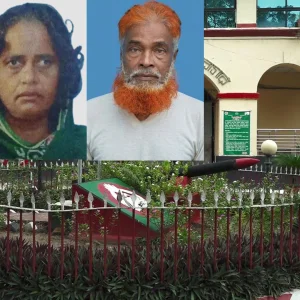
Forty-five Indian nationals remain imprisoned at Jessore Central Jail even after completing their sentences, because repatriation approvals have not come through. The bodies of two Indian prisoners from the same jail are lying in the morgue of Jessore General Hospital, awaiting a final decision from the foreign ministry.
One of the Indian nationals held in the jail was Bachul Majhi, a resident of Kakrara village under Mejorganj police station in Sitamarhi district of Uttar Pradesh. He was arrested on 22 February 2013 for illegally entering Bangladesh through the Ramgarhchhari border in Khagrachhari; the next day, a court sentenced him to six months' simple imprisonment.
After his sentence ended, he was transferred to Jessore Central Jail on 20 November 2018 to facilitate his repatriation. He then spent a long eight years in the jail even after completing his sentence. While in prison, he developed schizophrenia and various other complex illnesses.
On 9 October, when he suddenly developed chest pain, the prison authorities rushed him to Jessore General Hospital, where the doctor on duty declared him dead. Twenty days after his death, there is still no certainty about handing his body over to his family.
Like Bachul Majhi, the body of another Indian national, Gazi Mondal, is lying in the morgue of Jessore General Hospital. Gazi Mondal, a resident of Gandhina village under Marutia police station in Nadia district of West Bengal, was serving a life sentence of rigorous imprisonment in an arms case. On 19 October, he fell ill in prison and was taken to hospital, where doctors declared him dead.
The hospital authorities say the two bodies will be kept in the morgue until the foreign ministry's final decision arrives. Jessore General Hospital's supervisory physician Hussain Shafayat said: 'The hospital morgue has four chambers for keeping bodies. One of them has been out of order for a long time. Of the remaining three, two are occupied by the bodies of the Indian prisoners. We are in difficulty with the one free chamber; other bodies cannot be kept. We have written to the prison authorities asking them to take the next steps regarding the two bodies.'
According to the prison authorities, 52 Indian prisoners convicted of offences including illegal entry and drug offences are held at Jessore Central Jail. Of them, 45 have completed their sentences, but they remain in prison because repatriation approval has not been granted.
Many of these prisoners had sentences ranging from 15 days to two years. Yet even after completing them, they have had to spend eight to fifteen years in prison. Most of the prisoners are elderly: seven are women, and 24 are over 50 years old.
One of them is Charal Devi, a resident of Daudpur village in Bihar. She was arrested in Shariatpur on 12 January 2024 for illegal entry, and a court sentenced her to eight months in prison. Her sentence ended on 2 September that year, but she has still not been released.
The prison authorities say Charal Devi, 48, cries almost all the time. She believes India is just beyond the wall of Jessore Central Jail, and that if she could cross the wall she could return to her home in Bihar. Two years of waiting to return home, crying constantly, have taken a toll on her mental health. A woman prisoner held with her said Charal Devi's husband is named Santosh Dhord and her father-in-law Mithu Tiwari; she has two sons and two daughters. She used to sell clothes going from village to village, and she does not know how or when she came to Bangladesh.
Another prisoner, Gobinda Bihari, 47, was arrested in 2011 for illegally entering Bangladesh. A court sentenced him to one year in prison. Even after completing his sentence, he has remained in Jessore Central Jail for 14 years.
The prison authorities say that because the Indian prisoners have no passports, sending them back first requires repatriation approval from the home ministry's Security Services Division; the Indian High Commission or the relevant Indian authorities are then contacted. Most of these prisoners have received repatriation approval from Bangladesh's home ministry, but they cannot be sent back because approval from the Indian High Commission or the relevant authorities has not come.
Jessore Deputy Commissioner Mohammad Ashek Hasan said: 'Most of the prisoners have received repatriation approval from the home ministry's Security Services Division. But their release is not possible because approval from the Indian authorities has not come. The Indian High Commission has also been contacted, but no response as expected has been received yet.' He added that if sending them back through the High Commission proves impossible, the alternative of sending them back through the courts is also being considered.
Senior Jessore lawyer and cultural activist Aminur Rahman Hiru said: 'It is undoubtedly deplorable that a large number of Indian nationals are languishing in jail year after year even after completing their sentences. This is happening mainly because of our diplomatic weakness. The governments of both countries must come forward to deliver these people to their families.' Jessore Public Prosecutor Saberul Haque Sabu said the 45 have not been released despite completing their sentences because of complications in prisoner handover; the problem can be resolved quickly through talks at the foreign-ministry level of the two countries, and release is their human right.
Binoy Krishna Mallik, executive director of the human rights organisation Rights Jessore, said: 'However complex the legal and diplomatic process may be, such incidents must be settled quickly on humanitarian grounds. Besides, the right of the bodies lying in the morgue after death to a dignified funeral is connected to international human rights principles.'
The prison authorities say most of the 45 Indians awaiting repatriation are elderly and 24 are over 50, so alongside various physical illnesses they also face a risk of death. Years of imprisonment have also left many with mental health problems. The state is spending money on the living prisoners' food and lodging, while preserving a body after a death adds further cost — about a year ago, around 100,000 taka was spent on cold-storage rent for the body of one deceased Indian prisoner.