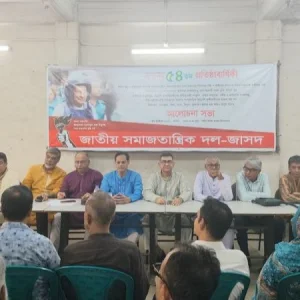
Only the ruler has changed, not the power structure: JSD leaders at Press Club discussion

Leaders of the Jatiya Samajtantrik Dal (JSD) have said that while the ruler has changed, there has been no fundamental change in the state's power structure. Power remains centralised, they said, and effective public participation in running the state has not been ensured. The party called for breaking the old power structure and establishing a democracy of partnership to move beyond the current situation.
The remarks came at a discussion titled 'Change the old power structure — transform the state through a democracy of partnership', held at the Jatiya Press Club on Saturday to mark the JSD's 54th founding anniversary, the party said in a press release. The discussion was chaired by JSD senior vice-president Tania Robb.
Speaking at the discussion, journalist Sohrab Hasan said the JSD had begun its journey with a pledge to build an exploitation-free society. Bringing a state reform programme to the fore now, he said, amounts to a kind of deviation from that ideological position. Even so, he argued, the struggle to empower the people must continue while accepting this reality.
Sharif Bhuiyan, a former member of the Constitution Reform Commission and a lawyer, said the aspirations of the July mass uprising, the national charter and the referendum verdict — even the pledges in the BNP's 31 points — are not being implemented. In his words, the elected BNP government is walking neither the path the people wanted nor the path of its own promises.
Sharif Bhuiyan added that a historic opportunity to carry out deep constitutional reform by implementing the referendum verdict has been missed. The demand to implement the national charter and the referendum verdict returned repeatedly throughout the discussion.
He also laid out his own proposal for how governance should be arranged. State power and the state structure, he said, must be organised so that even if direct public participation cannot be ensured, at least a people-centred system of governance can be established. Power must not remain person-centric; it must be broadened and decentralised, and separation of powers among the three organs of the state must be ensured. Without a change in the power structure, he warned, the state will slide back to where it was.
Political analyst Helaluzzaman Ahmad said that ensuring representation of developed social forces in the upper house of parliament would establish representation of the wider population in lawmaking, creating balance within the state's power structure.
JSD general secretary Shahid Uddin Mahmud said that throughout Bangladesh's political history, governments and rulers have changed again and again, but the centralised structure of power has never fundamentally changed. Power has changed hands, he said, but there has been no democratic redistribution of power, and effective public participation in state policymaking, resource distribution and decision-making has not been ensured.
In her chair's address, Tania Robb demanded implementation of the July national charter pledges and the verdict the people delivered in the referendum. She also called for forming a Constitution Reform Council and completing the necessary constitutional and institutional reforms.