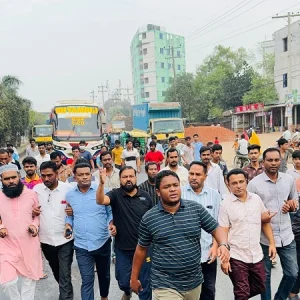
Governments Change but Political Violence Does Not: 94 Killed in 467 Incidents from January to September, Says ASK

On the night of 18 October, several men chased Ripon Mia in Paiska in Narayanganj district. At one stage he was attacked with sharp weapons. Family members took him to hospital, where doctors declared him dead.
Ripon was a local leader of the Jubo Dal, the youth organisation of the ruling Bangladesh Nationalist Party (BNP). Local BNP workers say a dispute between two sides over who would be on the guest list of a religious programme had recently intensified.
Ripon's daughter Sheela told the media that several men chased her father and hacked him to death. The local BNP president described the killing as linked to a fight for political influence and dominance.
On 28 February this year, two brothers were killed in clashes between supporters of the BNP and Jamaat-e-Islami in Chuadanga district in the west. Police said an argument after iftar in Ramadan turned violent. Hafizur Rahman died a few hours later. His brother, local Jamaat leader Mofizur Rahman, died on 10 March at a hospital in Dhaka.
The BNP and Jamaat blamed each other for the violence. After the family filed a murder case, police arrested three suspects including a local BNP leader and a former leader of the party's volunteer wing. The clash took place less than two weeks after the BNP returned to power.
The human rights organisation Ain o Salish Kendra (ASK) recorded 94 deaths and 3,587 injuries in 467 incidents of political violence from January to September this year.
Of these, 112 clashes were identified as 'BNP versus BNP'. In those clashes 18 people were killed and 1,215 injured. The statistics include incidents from both the interim government and the elected government periods. BNP chief Tarique Rahman took office as prime minister on 17 February.
Bangladesh has seen sweeping political change in recent years. After 15 years in power, Prime Minister Sheikh Hasina was ousted in the July 2024 mass uprising. An interim government led mainly by non-political figures then took over. A national election was later held and a political government formed. Yet amid all this change, deaths in the fight over who controls local areas continue.
Records going back to 2002 show that clashes between rival political parties, internal feuds within the ruling party and election-centred violence have occurred regularly. A party post, a business, a piece of land, even the guest list of a social programme can become the centre of a dispute over who holds authority in an area.
According to ASK statistics cited in political scientist Rounaq Jahan's 2014 research paper 'Political Parties in Bangladesh', during the BNP-led government from 2002 to 2006 ASK recorded 284 incidents of BNP internal feuding and 55 deaths. In the same period, 37 people died in Awami League internal feuding. BNP-Jamaat clashes in that period numbered 134 with eight deaths, and Awami League-Jamaat clashes numbered 42 with seven deaths.
During the military-backed caretaker government of 2007-2008, the rate of recorded party clashes fell. Only eight incidents of BNP internal feuding were recorded, with two deaths, and total deaths from political violence in the period were nine — whereas from 2002 to 2006, clashes between the Awami League and BNP alone killed 118 people. However, Human Rights Watch documented illegal arrests, torture and custodial deaths in that period.
After the Awami League returned to power in 2009, its internal violence rose again. From 2009 to 2012, 799 incidents of Awami League internal feuding killed 97 people. In the same period the BNP recorded 229 clashes and 21 deaths.
In 2013 ASK recorded 507 deaths from political violence. Its annual report mentioned 185 deaths in hartal-related violence and a further 85 deaths in the blockade programme that began on 25 November. Of the 507 people killed that year, 96 died in conflicts involving Jamaat or Shibir.
Local elections were another regular source of deaths. In 2016 ASK recorded 147 deaths in violence around the union parishad elections, out of 177 total deaths recorded from political violence that year. In 2021, 113 of the 157 deaths recorded nationwide came from violence around the union parishad elections.
A study by the BRAC Institute of Governance and Development reviewed reported political violence between 2008 and 2013. Analysing causes from 2008 to 2012, the study found that fights for dominance inside the parties were the biggest category. Disputes over contracting, property, land and jobs were also among the causes of violence.