People still manage three meals despite hardship, says Social Welfare Minister Zahid Hossain in Mithapukur
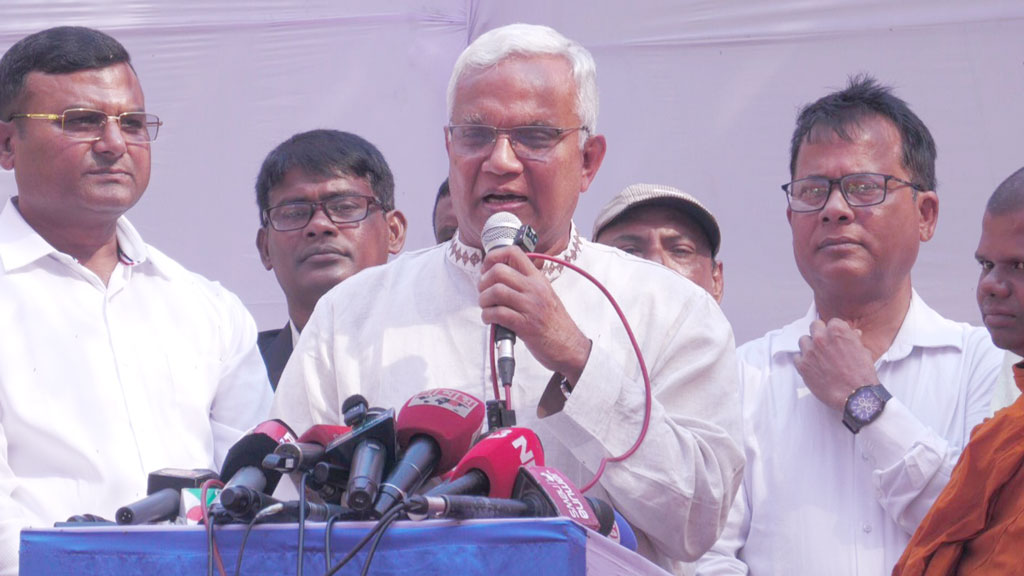
Social Welfare Minister Dr A Z M Zahid Hossain has said that despite many crises and great hardship, the people of the country are still able to eat three meals a day. Saying the deposed Awami League government had broken the backbone of the country's economy, he said Bangladesh has turned around under Prime Minister Tarique Rahman's leadership despite the devastated economy.
He made the remarks while speaking as chief guest at an indigenous Buddhist religious grand gathering held at Benuban Buddhist Vihara in Mithapukur upazila of Rangpur on Friday noon.
Criticising the previous Awami League government, the Social Welfare Minister said there had been widespread looting during its tenure. Eventually they were ousted from power and had to flee the country. They broke the backbone of the country's economy. In such a situation, the BNP and its chairman Tarique Rahman took responsibility for rebuilding the country, and the government is working accordingly, he said.
Outlining the country's economic situation, the minister said Bangladesh is turning around amid many crises. Rising commodity prices and the impact of higher fuel prices in the world market due to the Iran war have also affected the country's economy. In this situation, people are in hardship but are still able to eat three meals a day. He also said the government is taking various initiatives to ease people's suffering.
Calling for social unity to be maintained, the Social Welfare Minister said: 'We have to keep our unity intact and face all kinds of conspiracies and provocations. Those who have committed wrongdoing and crimes must come under the law. This country runs by the rule of law. Whoever commits wrongdoing will have to suffer punishment to that extent.'
The minister also said that to develop any area, no community living there can be left out. An inclusive society must be built together with people of all classes and professions, including Hindus, Buddhists, Christians, indigenous people, and the Santal, Chakma, Marma, Garo and Hajong communities.
In his words, Mithapukur's overall development is possible only by moving forward with everyone; real development is not possible by leaving out any community.