A betel nut trade worth a hundred crore taka has grown up in Chandpur's Haimchar, involving thousands of people
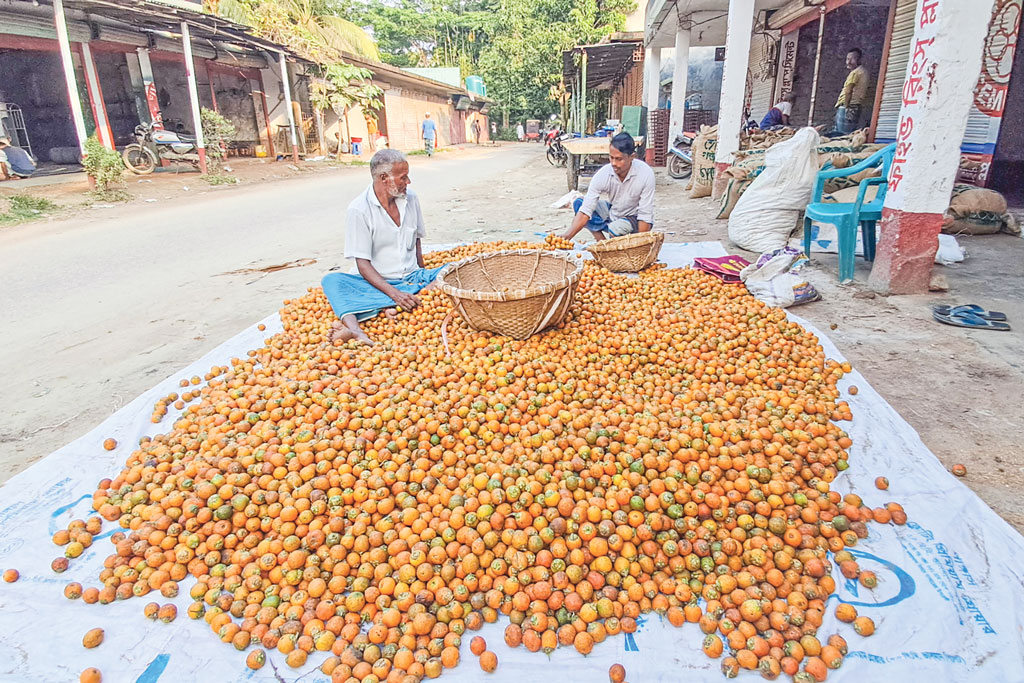
From home courtyards to commercial warehouses, the betel nut has added a new dimension to the economy. In Haimchar upazila of Chandpur, a market worth a hundred crore taka has grown up around this agricultural product. Betel nuts produced in local gardens are collected, sorted, preserved and marketed to the capital and various other regions of the country.
According to the farmers and traders involved, around Tk 100 crore worth of betel nuts are bought and sold in Haimchar every year. The crop, produced on 528 hectares of land in the upazila, meets local demand and has also found a place in markets in different parts of the country. From farmers' incomes to wholesale and retail trade, several thousand people are involved in this extensive supply chain.
Haimchar upazila, made up of only six unions across 134 square kilometres, has a total of 5,152 hectares of cultivable land. Betel nuts are grown on about 10 percent of that land. In the villages on the eastern bank of the Meghna, rows of betel nut trees stand in home courtyards, gardens and around groves.
For many families, these trees are a long-accumulated asset. Selling betel nuts in season covers a significant part of their household expenses.
The main production and marketing season for betel nuts runs from Bhadra-Ashwin to Agrahayan in the Bangla calendar. During this time, wholesale traders collect betel nuts from farmers in villages, markets and by the roadside across the upazila. The nuts are then taken to Hawladar Bazar, the upazila's largest wholesale depot.
At Hawladar Bazar, 10 to 15 large wholesale traders buy betel nuts from local producers and supply them to traders in different regions of the country.
Preservation also plays an important role in this trade. Some local traders buy raw betel nuts in season, sort them into large and small sizes, and preserve them soaked in water before sending them to different districts according to demand. This keeps betel nuts supplied to the market all year round, even after the production season. Farmers, collectors, depot owners, transport workers and retailers together make up a wide local economic activity.
However, the declining tendency to create new gardens and the cutting down of old betel nut trees have raised concerns about future production. Manik Sikdar, a resident of Ward No. 5 of Gondamara village, said that although betel nut production is good in Haimchar, the tendency to plant new trees is falling. Many people are cutting down old gardens to build houses and other structures, and he fears production will fall in future.
Rafiqul Islam Kazi, a trader at Hawladar Bazar, said the market price of betel nuts is comparatively good this year. At present, 80 betel nuts sell for Tk 160 to 200, and dried betel nuts sell for Tk 380 to 410 per kilogram. He claims that more than Tk 100 crore worth of betel nuts are bought and sold every year at Hawladar Bazar and the upazila's other markets.
Rob Hawladar, a veteran trader at Hawladar Bazar, has been in this business for about 40 years. He said betel nuts from Raipur upazila of Lakshmipur are also sold at this market's depots, alongside Haimchar's own. At Hawladar Bazar alone, Tk 35 to 40 crore worth of betel nuts are traded every year. Many families meet their whole year's household expenses from this income, and many families have become financially well-off around the betel nut trade.
Haimchar upazila agriculture officer Md Shakil Khandaker said the betel nut is a profitable agricultural product of this upazila, and cultivation, collection and sales activities around the crop continue all year. Farmers are getting a good price for betel nuts this year, he said, and the upazila agriculture department is providing the necessary support so that farmers can continue betel nut cultivation and production normally.
Local producers and traders have also demanded that imports remain stopped, to prevent foreign betel nuts from entering the domestic market.