From former allies to main rivals: BNP-Jamaat conflict spreads from parliament to the electoral field
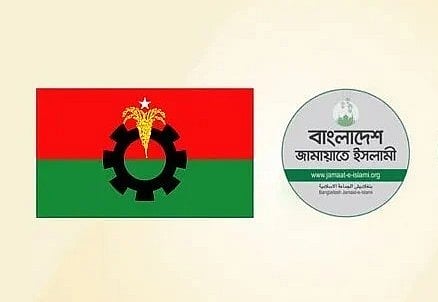
The political rivalry between Jamaat-e-Islami and the BNP is intensifying. The political competition that developed between the two parties after the fall of the Awami League government in the July mass uprising has now turned into an open conflict.
The conflict took on a new dimension around the national election of 12 February 2026. Its reflection was also seen in the Thakurgaon-1 by-election held on 29 October.
Before the election, the tit-for-tat statements by BNP and Jamaat leaders were seen as a strategy to gain strength on the voting field. After the BNP formed the government, the conflict widened further. Statements by top leaders of both parties, including Prime Minister Tarique Rahman, clearly show a tendency to confront each other politically.
Questions have been raised about what political calculation lies behind the conflict between the two former allies in the absence of the Awami League, whose activities are banned. Some political observers say ideological differences, vote competition, power calculations and the desire to establish political influence are all at work. How much of a concern Jamaat's growing political strength is becoming for the BNP is also under discussion.
In the election of 12 February 2026, the BNP formed the government with a majority. Jamaat, on the other hand, emerged as the main opposition force in parliament. That changed the equation of the two parties' relationship. Where Jamaat previously gained political advantage by staying in an alliance or joint movement with the BNP, it now has to establish its role as the opposition on the basis of its own strength and a distinct political identity.
In response to Jamaat's various criticisms, BNP chairman Tarique Rahman asked at an election rally in Rangpur on 30 January: if the BNP was so bad, why was Jamaat in government with the BNP from 2001 to 2006? Drawing on the past alliance, he also questioned the credibility of Jamaat leaders' criticism during the election campaign.
After the election, the conflict between the two parties also reached parliament. On 28 June, leaders of the two parties debated in the National Parliament over the leadership and credit for the July mass uprising. When the BNP highlighted Tarique Rahman's leadership, Jamaat Amir Shafiqur Rahman said the uprising had no single 'mastermind'; its credit belonged to the people and the youth.
Beyond tit-for-tat statements, strategic and political distance is also growing between the two parties over credit for the July uprising, the future of constitutional reform, implementation of the July Charter, the process of forming an interim government or appointing a chief adviser, and reform proposals. Those concerned also believe there is competition over the political position of the Awami League, whose activities are banned, and over its votes and organisational influence.
In several recent incidents the conflict has taken on a new dimension. When former MP Major (retd) Akhtaruzzaman, who left the BNP and joined Jamaat, was arrested, Jamaat alleged political vendetta. Jamaat-e-Islami Assistant Secretary General Hamidur Rahman Azad said, 'We are saying what we are saying seriously. In future we will take an even harder line.'
The conflict between the two parties also became public around the Thakurgaon-1 by-election. In that election on 29 October, BNP candidate Mirza Faysal Amin defeated the Jamaat candidate. The next day, Jamaat Secretary General Mia Golam Porwar accused the Chief Election Commissioner and the Election Commission Secretary of colluding with those responsible for irregularities. The Election Commission, on the other hand, expressed satisfaction with the voting environment.
BNP acting Secretary General Ruhul Kabir Rizvi said there was no concern within the BNP about Jamaat. But there was discomfort over its propaganda and misleading talk. Rizvi said, 'Yes, they (Jamaat) were once our political allies; but now they are acting as if they would have come to power, they were not allowed to come. The opposition will make constructive criticism, that is their democratic right; but if they keep making fabricated allegations on various issues continuously, then we have to say that because of their unrestrained behaviour democratic practice is at risk of being obstructed.'
In this context Rizvi cited the Thakurgaon-1 by-election as an example. He said such a beautiful election was held. There was no complaint all day, and towards the end of voting they raised various allegations to make the election controversial. It seems they have adopted a strategy of creating confusion in the public mind.
Talking to Jamaat leaders gives the impression that, even in opposition, they had expected some cooperation from their former ally the BNP; but they allege that expectation is not being reflected in reality. Rather, they believe areas where Jamaat has political influence are facing discrimination in various fields including development allocations. This discontent has also appeared in speeches by Jamaat members in the National Parliament.
One of the most important fields of the BNP-Jamaat conflict is the political future of the Awami League. In a speech on 1 October, Prime Minister Tarique Rahman, hinting at the Awami League and Jamaat, commented that an autocratic party and a secretive party had united. Earlier, in various speeches, BNP leaders also brought forward Jamaat's past political contacts and understandings with the Awami League.
At a public meeting in Rajshahi on 20 October, Prime Minister and BNP chairman Tarique Rahman said, citing clear intelligence, that the fugitive autocrat was supplying money to create labour unrest. Several parties that had tried to sell tickets before the election were also involved in it.
On the same day, at a press conference at the party's central office in Moghbazar in the capital, Jamaat-e-Islami Secretary General Mia Golam Porwar responded. He said the government was trying to shift all blame onto the opposition by raising a bogeyman to cover its own partisanship, failure and corruption. The opposition was never giving a fascist a chance to return; rather, by ignoring the opposition's movement an unstable situation was being created. Through this path they were deliberately making way for the Awami League to enter.
According to a section of people associated with politics, the BNP top leadership's remarks hinting at a 'fallen autocratic party' and a 'secretive party' are effectively a political strategy to 'kill two birds with one stone'. Its aim may be to keep both political rivals — the Awami League and Jamaat — under pressure. In particular, if Jamaat can be presented as a force inclined to compromise with the Awami League, an opportunity is created to raise questions about the party's political acceptability among anti-Awami League voters.
The BNP is now placing special importance on establishing itself as a liberal democratic and centrist political party. The party wants to take its future politics forward holding the values of the 1971 Liberation War, independence and sovereignty. In the conflict between the two former allies, ideological position has become important alongside vote and power calculations. The BNP is trying to establish a liberal and centrist identity by bringing the Liberation War and independence to the fore.