Organised journey of Bangladeshi nationalism began on 7 November 1975: Zahir Uddin Swapon in New York
The organised journey of the philosophy of 'Bangladeshi nationalism' began on 7 November 1975, the prime minister's political adviser Zahir Uddin Swapon has said. He said the sepoy-people's revolution of 7 November was not merely a historical event but the very foundation for restoring Bangladesh's independence, sovereignty and multiparty democracy.
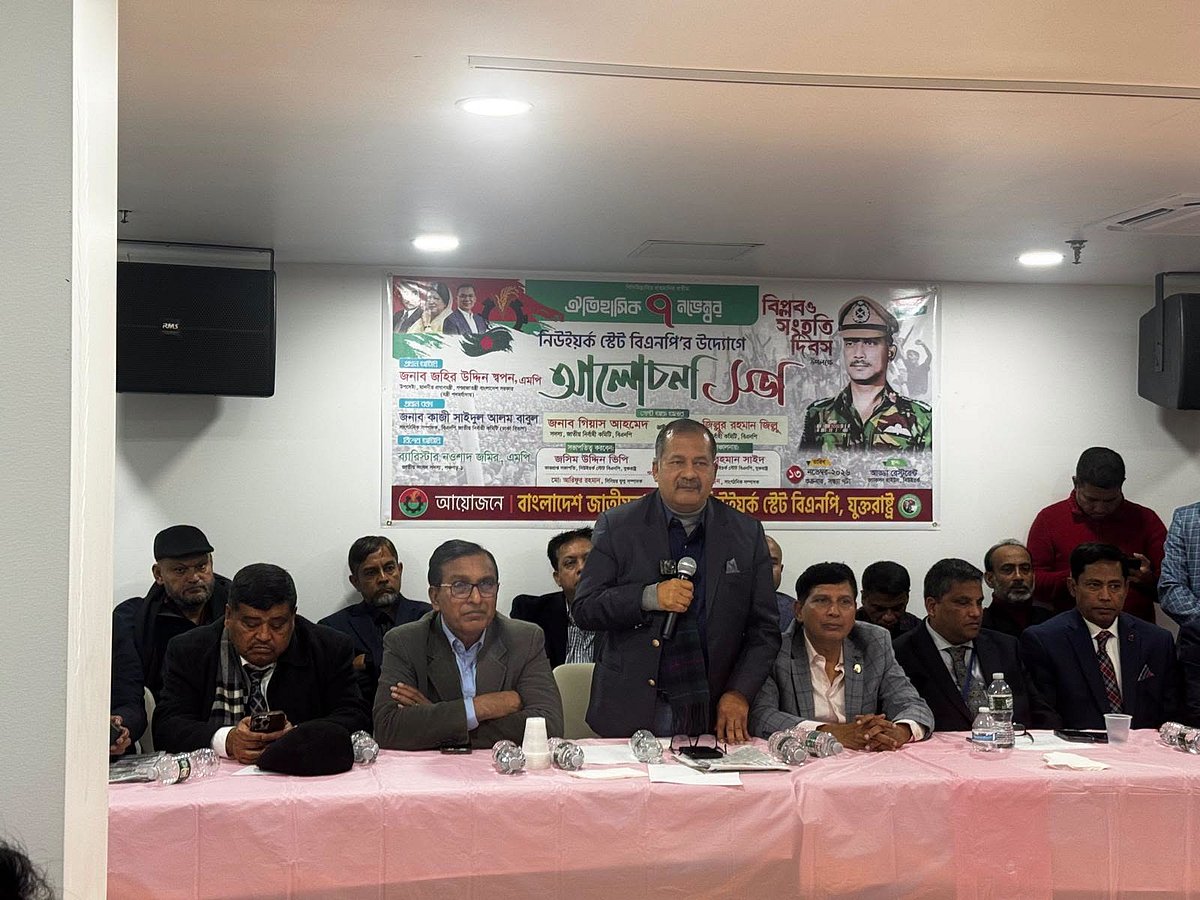
Zahir Uddin Swapon made the remarks as chief guest at a discussion organised by the BNP's New York State unit in the United States to mark National Revolution and Solidarity Day. The meeting was held on Friday evening local time at the Adda Restaurant Party Center in Jackson Heights, New York.
Zahir Uddin said Shaheed President Ziaur Rahman, holding the spirit of 7 November, had united a divided nation and at the same time begun building a self-reliant and prosperous Bangladesh.
The prime minister's political adviser called on everyone, including expatriate Bangladeshis, to work inspired by the spirit of solidarity to keep the country's democratic progress going and protect its sovereignty in the current global and political context. He said BNP leaders and activists living abroad continue to play an important role in the country's democracy and development.
The meeting was chaired by New York State BNP president Jasim Uddin. BNP international affairs secretary and member of parliament Nawshad Zamir was present, along with a large number of leaders and activists of the BNP and its affiliated organisations.
A second discussion was held on 15 November, jointly organised by the Bangladesh Consulate General in New York and the Permanent Mission of Bangladesh to the United Nations to mark National Revolution and Solidarity Day. Zahir Uddin Swapon also spoke as chief guest at that meeting, held in the auditorium of the Bangladesh Consulate General office in New York.
There he called for building a discrimination-free, democratic and self-reliant Bangladesh holding the historical spirit of sepoy-people solidarity. He said 7 November 1975 was no single group's event; it was the spontaneous unity of the armed forces and ordinary people to protect the country's sovereignty, and that revolution opened the path of multiparty democracy and production-oriented politics.
He also said the historic turn created on 7 November 1975 on the path of the country's independence, sovereignty and democratic journey remains highly relevant to the state and political reforms of the present time.
Referring to the role of expatriates in the country's times of crisis and economic progress, the prime minister's political adviser said expatriate Bangladeshis have always played a leading role in every crisis and in the economic advancement of the country. He urged them to keep their talent, experience and remittance flows going to accelerate the present government's development and reform drive, and asked everyone to work unitedly to brighten Bangladesh's image abroad.
The discussion was chaired by Bangladesh's Consul General in New York, Mozammel Haque Peter. Special guests who spoke included Nawshad Zamir, chairman of the parliamentary committee on law; Sanchita Haque, acting chief of the Permanent Mission of Bangladesh to the United Nations; and Golam Mortaza, press minister at the Bangladesh embassy in Washington.
Nawshad Zamir presented the historical background and constitutional importance of 7 November. He said maintaining national solidarity and strengthening the rule of law and democratic institutions is the main demand of the time.
Sanchita Haque, acting chief of the Permanent Mission to the UN, recalled Bangladesh's diplomatic position internationally and the contribution of expatriates to the country's progress. Golam Mortaza, press minister at the Washington embassy, emphasised the need for free media, democratic values and national unity.