Facing the Iranian Threat, the US Is Pulling Bombers Out of Its UK Bases, Raising New Security Anxiety Among Allies
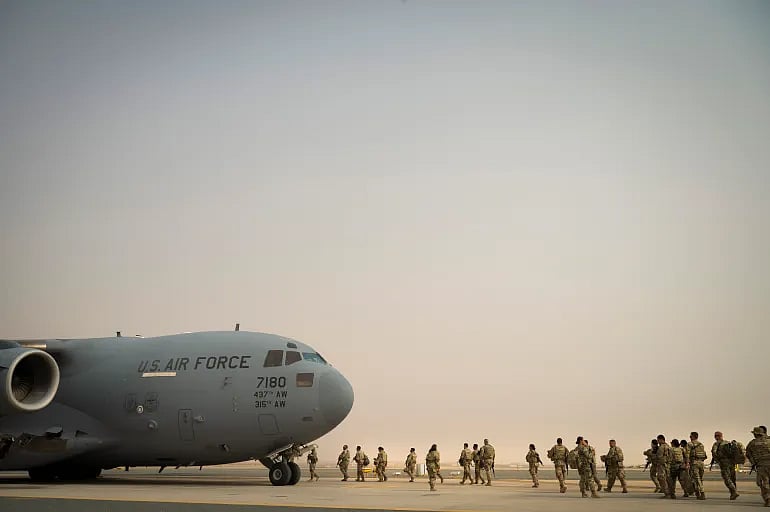
In October the United States removed 12 of its B-1 Lancer bombers from the Royal Air Force's Fairford base in Gloucestershire, United Kingdom. Washington took the decision out of concern that, in the face of Iran's growing threat, the base is no longer safe.
A few days earlier, UK security forces had arrested several people. The country's government alleged that a plot to attack the Fairford base had been foiled and that Iran was behind it. Tehran, however, has denied the allegation.
It is not only Fairford; the United States has also begun removing military equipment from other bases. At the start of this month, 12 US warplanes were removed from another UK base, RAF Mildenhall.
Reports in July said that several US bases in the Gulf region had been heavily damaged in Iranian attacks during the war. Equipment from those bases was then quickly moved to Jordan. Washington is also considering a proposal to transfer some of that equipment to Israel.
Many experts say these events have created a new security crisis for US allies in the Gulf and Europe. By allowing US forces to base themselves on their soil, the countries concerned are being exposed to retaliatory attack in a war over whose launch they had no say.
Fairford's role goes back a long way. In March 1999 a US B-52 bomber took off from the base, and within two minutes seven more warplanes followed on the same route; that day the US-led NATO campaign against the then Yugoslavia began. The base was also used as a refuelling centre for the warplanes taking part in the campaign. Earlier, in the 1991 Gulf War, the base played the same role, and US forces used it again during the 2003 Iraq war. Most recently it was used in the opening phase of the US and Israeli attack on Iran that began on 28 February this year.
Iran has invested heavily in building low-cost drones with its own technology. With these drones, major damage can be inflicted on targets at comparatively low cost. To intercept them, the opposing side has to use far more expensive missiles, which raises its cost of war.
Simon Mabon, professor of international politics at Lancaster University in the UK, says the US security umbrella is increasingly becoming a double-edged sword. He adds that as questions arise over the security of US military bases, Washington's calculations about their strategic value are also changing; at the same time, European and Gulf countries are having to think afresh about these bases, because they are increasingly becoming targets of attack.
US prosecutors have charged three individuals. They claim all three were backed by Iran and were involved in planning around 20 attacks across the United States and Europe. The targets included RAF Fairford in the United Kingdom.
Iran has stated plainly that its reason for attacking neighbouring countries in the Gulf region is that US military bases are located in them. Tehran has already attacked Qatar, the United Arab Emirates, Saudi Arabia, Bahrain and Kuwait. It has also attacked Omani territory, although Oman has no permanent US military base. Outside the Gulf region, Jordan and Iraq have been attacked; both countries host quite large US military installations.
A September report by the Pentagon's watchdog said that in the first four months of the war, several hundred structures at US military installations in Kuwait, Qatar, Bahrain, the United Arab Emirates, Saudi Arabia, Iraq, Oman and Jordan were damaged or destroyed. In an attack on Saudi Arabia's Prince Sultan Air Base, at least five KC-135 aircraft were damaged; these aircraft refuel other planes in mid-air. In a later attack, at least one airborne surveillance and control aircraft on the ground was damaged.
US President Donald Trump said last Monday that there is no need, for now, to continue military operations against Iran. However, the US naval blockade of Iranian ports remains in force, and shipping through the Strait of Hormuz has not fully returned to normal.
Middle East analyst Mohammad Ali Shabani says the presence of US military installations has now become a major concern for the governments of the countries concerned. These countries did not want a war with Iran; but without any real chance to have their say, they have been drawn into the war.
Last March an Iranian drone struck a hangar at a UK military base in distant Cyprus; the United States also uses that base for intelligence gathering and logistics. Before that, Iran had threatened NATO member Bulgaria, after reports that the country had allowed the US to use its Bezmer air base. A few weeks later Bulgaria's defence minister said US tanker aircraft had permanently left the Bezmer air base, and the country's president also declared that 'the operation is over'.
Many analysts believe several important military bases used by US forces in the Middle East have effectively become inoperative, with Kuwait's bases the worst hit. In an Iranian attack on Kuwait's Shuaiba port, six US service members were killed and an operations centre was destroyed. At Ali Al-Salem Air Base, Iranian drone and missile attacks injured several people and damaged aviation facilities.