
29 Percent of Highly Educated Youth Unemployed, Skills Gap Cited as Key Cause
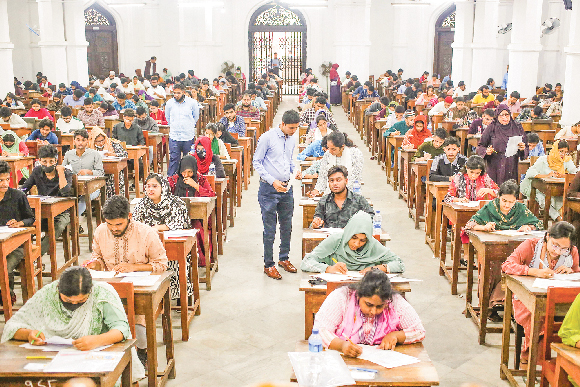
Every year thousands of students in Bangladesh try to enter working life with higher education certificates in hand. But a degree alone does not guarantee a job — many lack the necessary practical knowledge and technical skills. Research cited in the discussion says 29 percent of highly educated young people are unemployed.
A large share of the highly educated unemployed are bachelor's and master's degree holders who passed from the National University. While the number of certificate holders is rising, the gap between the demand for and supply of skilled manpower is also widening.
There are currently 172 public and private universities in the country. Of them, 56 are public and 116 are private. There are 2,257 colleges affiliated with the National University, of which 555 are government colleges. The figures are from the UGC Annual Report 2023.
The discussion noted that many students, even while studying at honours and master's level, cannot speak or read Bangla and English correctly. Many also lag in the basic skill of expressing their own views clearly.
It was alleged that honours and degree pass courses have been opened in many private colleges in rural areas without qualified teachers, rich libraries or practical education facilities. The condition of many government colleges at upazila level is the same, and classes are not held properly, it was said.
Employers now look for workers who can solve real problems, use technology and communicate effectively. Quoting an industrialist, it was said that when he takes interviews to give jobs, he cannot find qualified candidates.
To overcome this crisis, the discussion stressed project-based education, links with industry, research, proper use of information technology and hands-on learning, instead of emphasising only theoretical study and passing exams.
The need to create new employment was also raised. For this, increasing investment in the country, expanding industrialisation and removing obstacles to domestic and foreign investment were highlighted.
As a proposal, restructuring the National University's current structure to establish a 'National Vocational University' was put forward. Its main goal would be not just to award certificates, but to create skilled manpower according to the needs of the economy and the labour market.
Under the proposed structure, region-based centres would offer diplomas, degrees and training in agriculture and agricultural technology, industrial production, information technology, health services, marketing, business and accounting, tourism, hotel management, construction, electricity and electronics, among other professions. Hands-on learning, internships and practical training would be mandatory in every course, it was said.
However, it was also noted that this change does not mean closing the path of general higher education. The importance of basic knowledge in literature, history, philosophy and science would remain, and institutions with qualified teachers and infrastructure would continue, it was said.
The discussion said a university's success does not lie in a huge campus or student numbers — it depends on creating new knowledge, research, innovation and the ability to produce skilled manpower. The value of education lies not in the certificate, but in applying acquired knowledge and skills in real life.


