Plastic waste smothers Sundarbans breathing roots, crabs and snails decline; microplastics found in every fish tested
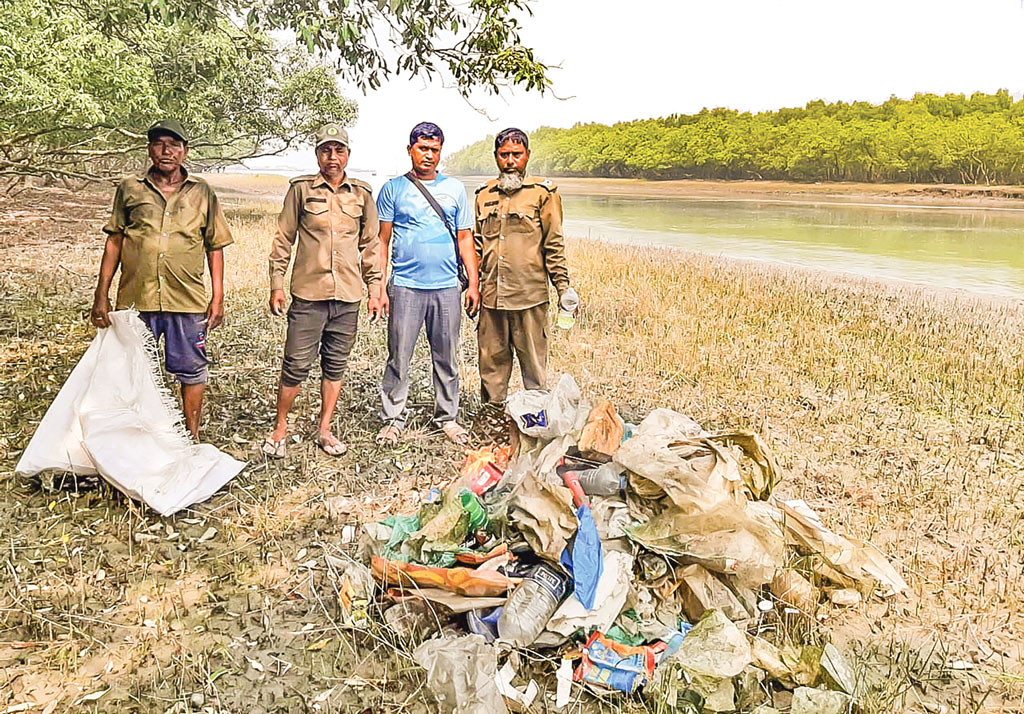
Plastic waste is covering the breathing roots of trees in the Sundarbans, the world's largest mangrove forest. Discarded fishing nets and polythene are blocking the growth of new saplings, and in the places where plastic piles up the most, crabs, snails and other aquatic animals are being seen less and less. On top of that has come microplastics — the tiny particles are now being detected in the water, the soil and the bodies of aquatic animals. The picture has been seen on visits to different parts of the forest, and international research shows the same. Yet there is still no effective action.
On recent visits to Katka, Kochikhali, Jamtala, Dimer Char, Andharmanik and other areas of the Sundarbans, polythene, nylon nets, plastic bottles, rope, cork sheet and other waste were found piled around tree bases, around the breathing roots and on the forest floor. At Dimer Char, large amounts of plastic were seen mixed in with the plant seeds that float in on the tide.
Forest-dependent people from Sharankhola in Bagerhat and Patharghata in Barguna describe the same picture. They say that in the spots around Katka, Kochikhali and Dimer Char where plastic waste accumulates the most, crabs, snails and other bottom-dwelling creatures are moving about less than before.
Experts say abandoned nets and plastic rope tangle around new saplings and obstruct their normal growth, while in places polythene has settled over the trees' breathing roots. They also report falling rates of natural seedling growth and declining plant density in these areas, though they say scientific testing is needed to confirm the role of plastic waste in these changes.
Sheikh Tarek Arafat, a professor and researcher in the Fisheries and Marine Resource Technology discipline at Khulna University, says large plastic waste slowly breaks down into tiny particles and mixes with the soil. These microplastics can enter the bodies of crabs, snails and other animals, and there is concern that this could damage their normal activity and reproductive capacity. Plastic may also be behind the reduced movement of animals in polluted areas, he says.
Bangladeshi research has also found evidence of microplastics in the Sundarbans' aquatic ecosystem. In a study published in Science of the Total Environment in 2022, researchers detected microplastics in animals at different levels of the Sundarbans' aquatic food chain — an average of 0.56 particles per primary consumer animal, and an average of 4.17 particles in consumers at the fourth level of the food web.
A Khulna University study conducted from 2020 to 2022 found an average of 2.22 microplastic particles per litre of water and 734 particles per kilogram of soil in samples from six Sundarbans locations. Another study published in 2023 found microplastics in the digestive tracts of all 64 fish of eight species collected from the Sundarbans and the rivers and canals of Bangladesh's western coast — an average of 7.1 particles per fish. Bottom-dwelling fish averaged 7.78 particles, while fish living in the upper water averaged 5.92.
Dr Gawsia Wahidunnessa Chowdhury, a professor and researcher in the Zoology Department at the University of Dhaka, says the impact of plastic pollution can fall directly on the forest's ecosystem, and research has shown microplastics in animals at different levels of the Sundarbans' aquatic food chain. The tiny particles can pass into different animals' bodies through the food chain, though more specific research is needed to determine the long-term damage. 'There is only one Sundarbans,' she says. 'If it is destroyed, we have no alternative option.'
Concerned quarters say that while there has been research on microplastics in the Sundarbans' water, sediment and aquatic animals, research is also needed on the direct damage that visible plastic waste does to plants, natural regeneration and bottom-dwelling animals. Long-term comparative studies are needed on plastic-covered breathing roots, sapling growth, seed germination, tree vitality and changes in crab and snail habitats. Alongside removing plastic waste, determining the nature and scale of this damage is essential, say university teachers who work on the environment.
Mohammad Rezaul Karim Chowdhury, divisional forest officer of the East Sundarbans, says the Forest Department faces a manpower crisis, with 140 forest guard posts vacant. Within these limits, the department regularly collects plastic waste from the forest and dumps it in Bagerhat and Khulna, but that is far less than the waste spread across the vast Sundarbans. Tourists have been asked not to carry single-use plastic inside the forest, and forest guards check regularly. But the huge volume of plastic waste drifting in from the sea and the rivers is the big crisis for the Sundarbans, he says.