HSC Results Slump for a Second Straight Year: Pass Rate Falls to 52.12 Percent as Educationists Question Learning Deficit and Assessment
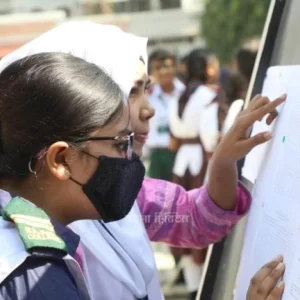
In the HSC and equivalent examinations, the pass rate and the number of students achieving GPA-5 have fallen for two years in a row. In 2024 the pass rate was 77.78 percent. In 2025 it dropped to 58.83 percent. This year it has fallen further to 52.12 percent. Over the same two years, the number of GPA-5 achievers has dropped from 145,911 to 40,084 — a decline of 105,827.
This year, of 1,240,798 candidates across 11 education boards, 646,685 passed and 594,113 failed. Compared with last year, the pass rate fell by 6.71 percentage points and the number of GPA-5 achievers fell by 29,013. The decline appears not only in the overall results but also in stream-wise, board-wise and institution-wise results.
Educationists say factors behind the results must include a long-standing learning deficit, the lack of effective initiatives to make up post-Covid losses, unrest on campuses, disrupted teaching, teacher shortages and changes in the assessment method. However, they say subject-wise and institution-wise data must be analysed to pinpoint the causes of the decline.
Large gaps appeared between streams. The pass rate in science was 73.12 percent, in business studies 50.77 percent, and in humanities only 42.17 percent.
In the humanities stream the boys' pass rate was even lower, at 35.01 percent, against 47.49 percent for girls — a gap of 12.48 percentage points. In science, the pass rate was 71.60 percent for boys and 74.55 percent for girls.
Girls also stayed ahead in the gender-wise results. Of 607,649 boys who sat the exam, 290,157 passed, a rate of 47.75 percent. Of 633,149 girls, 356,528 passed, a rate of 56.31 percent. The girls' pass rate was 8.56 percentage points higher than the boys', and girls were ahead in the number of GPA-5 achievers as well.
Among the general education boards, Dhaka Board led with a pass rate of 61.80 percent, while Barishal Board was at the bottom with 44.84 percent. The other rates were Rajshahi 45.06, Cumilla 48.04, Jashore 44.92, Chattogram 52.07, Sylhet 50.90, Dinajpur 45.98 and Mymensingh 51.44 percent.
The average pass rate across the nine general boards was 51.62 percent. The Madrasa Education Board recorded 61.07 percent and the Technical Education Board 49.43 percent, meaning the technical results were below even the general boards' average. Although the madrasa results were comparatively higher, that stream was not free of the overall decline either.
Institution-level results were also worrying. The number of institutions with zero passes rose from 202 in 2025 to 293 this year, an increase of 91 in one year. Institutions with a 100 percent pass rate fell from 345 last year to 139 this year, a drop of 206.
Analysing the HSC results, educationist Rasheda K Chowdhury said no effective initiative was taken to make up the post-Covid learning deficit, and the expected returns from education investment were not achieved. Campuses saw unrest over the last two years, and there is a shortage of skilled, subject-based teachers in most areas of the country, not only at village level. These factors created a teaching deficit for students, she said.
Rasheda K Chowdhury said another cause of the learning deficit is dependence on guidebooks and coaching. Because necessary teaching is not happening in classrooms, many students have become dependent on guidebooks and coaching, but real learning cannot be achieved by reading guidebooks. She also noted that natural disasters affected students' studies.
Welcoming the decision to let students who failed one or two subjects retake the exam within a month, Rasheda K Chowdhury said an opportunity to sit the exam alone will not be enough. Alternative arrangements are also needed for those who failed more than two subjects. Technical and vocational education, skills development training and language-learning opportunities could be offered to these students, she said.
However, Professor Syed Akhtaruzzaman, chair of the Inter-Education Board Coordination Committee and chairman of the Dhaka Education Board, sees the results differently rather than as a disaster. He said that for those who studied, this year's results are not a disaster at all; they are a disaster for those who sat the exam without studying.
Professor Syed Akhtaruzzaman said there is not much of a teacher shortage at the intermediate level. The main problem, he said, is that students do not come to class. Outside urban areas, he does not think more than 50 percent of students attend classes regularly in any institution; at most 30 to 35 percent attend. Those who attend class have a higher pass rate, he said, adding that parents also need to be aware of this.
The assessment method has also come under discussion after the results. The education minister has said candidates were given exactly the marks they deserved and marks were not artificially inflated. Education researcher K M Enamul Haque, on the other hand, believes a rise or fall in results has no direct relationship with the quality of education, and that an acceptable standard for awarding marks must be set alongside fundamental changes in the education system.
The education ministry has said 422,905 students who failed one or two subjects will be given the opportunity to retake those subjects, with a plan to hold the exam within a month. But the total number of failed students is 594,113, and what arrangements will exist for those who failed three or more subjects has emerged as an important question.
All told, the trend of results across 2024 to 2026 has raised fresh questions about learning, teaching and assessment in the education system. According to educationists and those concerned, merely making marking stricter or offering re-exams to failed students will not solve the problem; effective initiatives must be ensured for basic skills, subject-based teachers, regular teaching and making up the learning deficit from primary to higher secondary level. At the same time, detailed board- and institution-wise data and impartial research are needed to know the real causes of the results.