A 500-year-old memory recovered from beneath the soil: Chapainawabganj's Darasbari Mosque
The pages of Bengal's history are filled with countless architectural remains of the Sultanate period. Somewhere an ancient mosque still stands tall; elsewhere, brick and stone ruins survive as witnesses of time. One such historic structure is the Darasbari Mosque in Chapainawabganj. Surrounded by mango orchards, an ancient pond and greenery, the mosque carries several centuries of history. Though now largely in ruins, its architecture and past continue to fascinate history lovers.
The Darasbari Mosque stands near Omarpur in Shibganj upazila of Chapainawabganj, between the Chhota Sona Mosque and the Kotwali Darwaza. The structure, close to the Bangladesh-India border, is not far from the Sonamasjid land port either. Reaching the banks of the Mahananda river and walking through mango orchards brings the ancient mosque into view, with the ruins of the Darasbari Madrasa nearby.
According to historical records, the mosque was built in 1479 (884 Hijri) during the reign of Bengal Sultan Shamsuddin Yusuf Shah, on his orders. It was once known as the Firozpur Jame Mosque. An Arabic inscription found at the mosque reveals the date of construction and the identity of the ruler. Historian Munshi Elahi Bakhsh discovered the inscription during his research; it is now said to be preserved in a museum in Kolkata.
Later, an educational centre or madrasa named Darusbari grew up in this area. Several historical accounts also mention the founding of a Darusbari university in 1502, during the reign of Sultan Hussain Shah. It is believed that as the educational centre became well known, the Firozpur Jame Mosque also came to be known as the Darasbari Mosque. The Arabic word 'dars' means lesson or study, hinting at the name's link with the centre of learning.
British archaeologist General Alexander Cunningham also referred to the structure as Darasbari, or a college. This suggests that alongside the mosque, the site once hosted an important environment of learning.
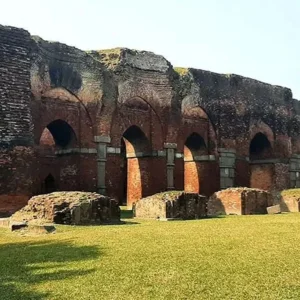
Built of brick, the Darasbari Mosque was once even larger than the Chhota Sona Mosque, according to historical accounts. Its main building measures about 99 feet 5 inches in length and 34 feet 9 inches in width. On the eastern side stood a veranda with domes of various sizes resting on stone pillars, and the main building itself was topped with nine domes.
The western wall of the mosque had nine ornate mihrabs side by side, while the northern and southern walls had windows. A separate space was also arranged in the north-western corner for women to pray. These features offer an idea of the building style of religious structures of the Sultanate era.
Over time, however, most of the mosque has been destroyed. Parts of the surrounding walls, the bases of stone pillars and traces of a few mihrabs are all that remain. The Darasbari Mosque lay buried under the soil for a long time, until archaeological excavations in the early 1970s brought it back to light. Even after its recovery, decay and a lack of proper care have destroyed much of the structure.
Today the mosque, wrapped in trees and greenery, is largely deserted. Nearby stand the ruins of the Darasbari Madrasa and an ancient pond. Together, the whole area seems to carry the memory of a lost settlement of the past.
A visit to the Darasbari Mosque offers not just one ancient structure, but many traces of the history and architecture of Sultanate-era Bengal. The surviving mihrabs, stone pillar bases, old brick walls and the nearby pond can all be explored, and with time in hand, the nearby Chhota Sona Mosque and Kotwali Darwaza can be visited as well. The Darasbari Mosque is therefore not merely a religious structure, but an important monument of Bengal's history and heritage.