Singhimari in Kurigram: The Village Where Fifty Children Learn Folk Music for Free
A road branching off the Kurigram-Rangpur highway at Chhinai Bazar leads to the green village of Singhimari. Entering the village, children's voices carry Lalon's famous song 'Manush Bhojle Sonar Manush Hobi.'
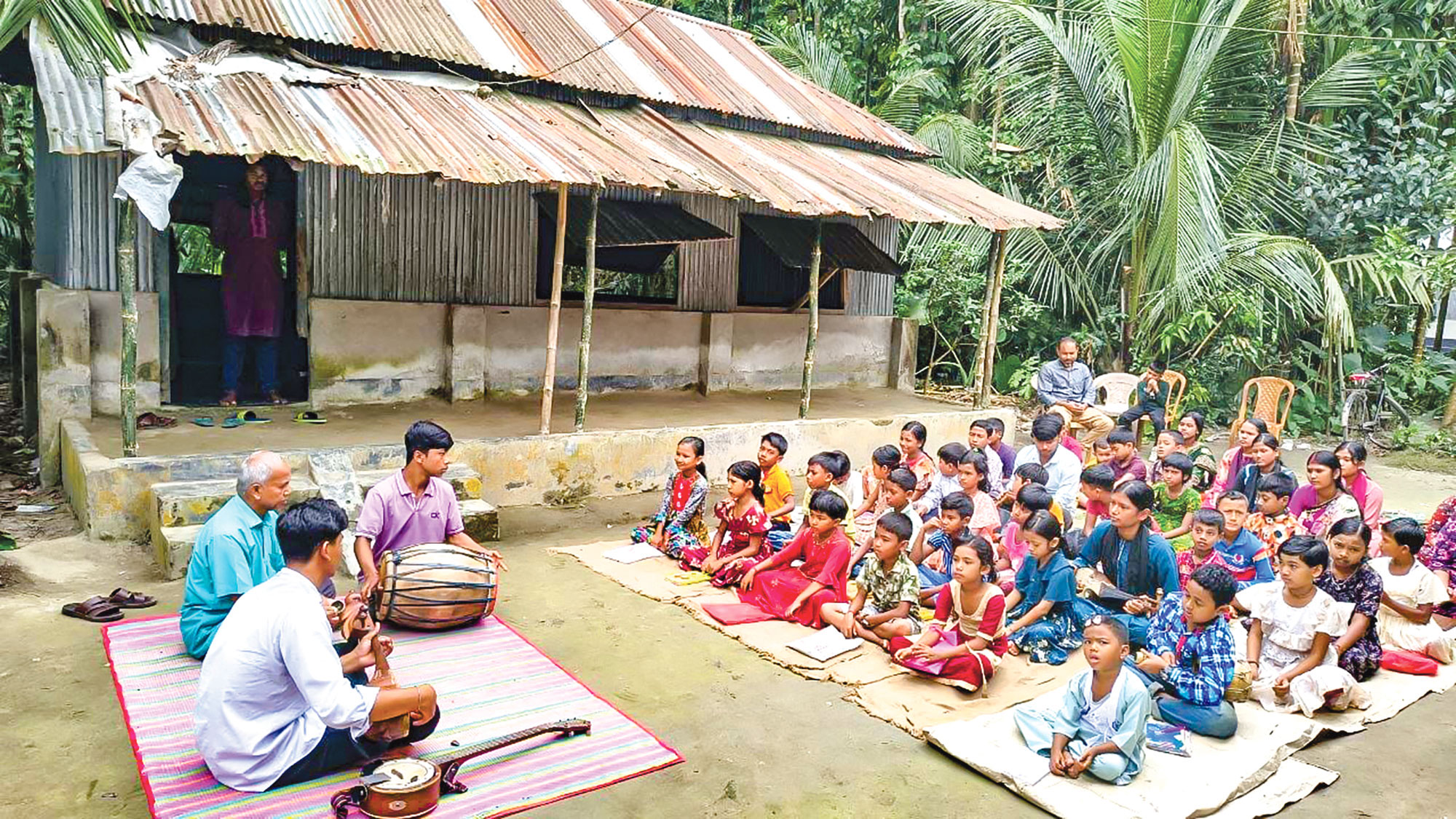
Following the music leads to the courtyard of a house, where around fifty children sit learning songs to the rhythm of folk instruments.
Singhimari village in Baidyerbazar, Rajarhat upazila of Kurigram, has in this way become a village of folk music. The main sessions are held at the home of village musician Narayan Chandra Roy, the folk-instrument instructor and chief guru, so his house is known as the 'Sebaloy Gurugriha.'
At Sebaloy, children and teenagers are taught folk music and folk instruments free of charge every Friday and Saturday. The programme has run for a decade to pass a fading folk culture on to a new generation.
In the gurugriha, children sit before their gurus with dotara, ektara, flute or tabla. Lessons in melody run alongside folk-song practice; when they make mistakes, they try again under the guru's guidance.
Instructor Narayan Chandra Roy said an organisation called Mayer Tori runs not only Sebaloy but four gurugrihas in Kurigram and five in Lalmonirhat. All nine teach folk music and folk instruments free of charge, each with local cultural workers and instructors attached.
Narayan Chandra Roy believes folk instruments are not merely entertainment; they carry a nation's history, heritage and identity. Under his supervision, children learn not only how to play but also love for melody and the discipline of practice.
Mayer Tori began with a foreign woman's fascination with this country's folk culture. One of its organisers, journalist and cultural worker Yusuf Alamgir, said Norwegian poet, writer, folk researcher and photographer Ueya Seth visited Rowmari in Kurigram in 1998, where mystical songs sung by local women deeply moved her. She later translated 53 of Lalon's songs into Norwegian, and in 2016, with her patronage and local cultural workers, Mayer Tori was founded.
Sebaloy student Sathi Roy said, 'I have been learning singing and instruments here for 10 years. We want to learn and teach others.' Parent Aduri Roy said she was proud that her daughter and son learn music and instruments at Sebaloy in this remote village.
The work runs entirely on voluntary labour. Sebaloy gurus Nimai Chandra and Nirmal Chandra say folk-music practice is not limited to teaching songs; through it, children can be introduced to a rich cultural heritage.
Funding, however, is a major challenge. Running the institutions, collecting and repairing instruments, instructors' honorariums, travel and infrastructure development all require money, and organisers said a lack of funds sometimes makes necessary initiatives hard to carry out.
Mayer Tori executive director Sujon Kumar Bed said bringing the nine gurugrihas under one integrated cultural education system would allow the initiative to expand further; it needs a permanent training centre, instruments, instructors' honorariums and institutional support. He wants the work to spread beyond Kurigram and Lalmonirhat to other regions of the country.
The organisers' plans include an 'Ananda Ashram' for elderly folk artists, bauls, bhawaiya singers and instrumentalists, a digital archive preserving the north's disappearing folk songs and artists' voices, and the dream of a full folk-music institute.
Yusuf Alamgir believes keeping culture alive is not the responsibility of artists or cultural organisations alone; it is a collective duty of the state and society. Folk culture, he says, is not the sole property of any one community or region and should not be confined to festivals or special-day formalities.