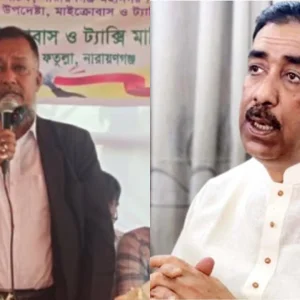
'We Will Not Accept Partial Amendments' — DUCSU GS Farhad Announces Boycott of Special Committee Meeting

SM Farhad, general secretary (GS) of the Dhaka University Central Students' Union (DUCSU), has announced a boycott of an exchange meeting of the Jatiya Sangsad's special committee, alleging that a move is under way to partially amend the constitution while ignoring the verdict of the referendum. He claims an attempt is being made to keep the old constitutional structure in place instead of implementing the reform mandate approved by the people's direct vote.
In a Facebook post on Tuesday (3 November), Farhad said the exchange meeting of the special committee on constitutional amendment was scheduled to be held at 2:30 pm that day at the Jatiya Sangsad Bhaban. Although he had been invited to the meeting as DUCSU GS, he and DUCSU had decided to boycott it, he said.
Farhad said that after the July-August 2024 mass uprising, the candidates who contested the DUCSU election and the students who voted had expected a state to be built where fascism could never rise again, where a democratic environment would be ensured in educational institutions, and where a discrimination-free, justice-based state would be established.
The DUCSU GS gave three reasons for the boycott. First, he alleged that the verdict expressed through 68.59 percent 'yes' votes in the referendum and the July National Charter 2025 were being betrayed. He claimed the government and the parliamentary committee wanted to preserve the old constitutional structure through partial amendments instead of implementing the reform mandate approved by the people's direct vote.
Second, Farhad noted that although Article 142 of the constitution gives parliament the power to amend the constitution by a two-thirds majority, parliament has no power to change the basic structure. In his words, 48 clauses of the July National Charter — including a bicameral parliament, a balance in the prime minister's powers, the restoration of the caretaker government system and the independence of the judiciary — are tied to the constitution's basic structure, so these reforms cannot be properly reflected through a parliamentary committee.
Third, he expressed concern that a one-sided amendment under the existing constitution could face a challenge in the Supreme Court in future, citing the annulment of the fifth, eighth and thirteenth constitutional amendments as examples. In his view, amending through members of parliament without forming an independent constitution reform council could raise questions about the legal durability of the reform initiative.
Farhad said they would not accept a partial and motivated amendment of the constitution. He demanded that the process be stopped immediately and an independent 'Constitution Reform Council' be formed in line with the July Charter, in accordance with the mandate of 69 percent of the people in the referendum.
However, he also said DUCSU was ready to cooperate with any honest and inclusive initiative for state and constitutional reform. At the same time, Farhad made clear that DUCSU would not take part in any process aimed at implementing a one-sided political agenda.