After Wage Board Formation, Labour Leaders Call on Savar-Ashulia Workers to Return to Work
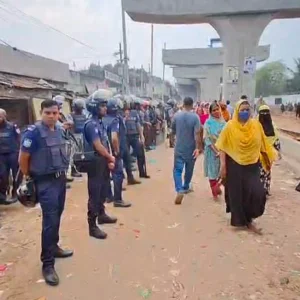
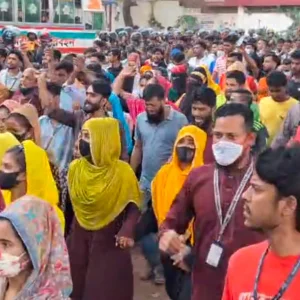
Amid worker unrest and halted production in the Savar-Ashulia industrial area, labour leaders have called on workers to return to work and keep production running now that a wage board has been formed. Several Savar-Ashulia labour leaders spoke by phone on Thursday night and said they no longer see any practical scope for continuing the movement on the ground. At the same time, they demanded that the government ensure workers' safety.
According to the labour leaders, the workers' main demand was the formation of a wage board and the implementation of a new wage. Now that the government has formed the wage board, workers should return to the factories. However, they said an environment for returning must be created by ensuring workers' safety and trust.
Khairul Mamun Mintu, legal affairs secretary of the Bangladesh Garments and Sweaters Workers Trade Union Centre, said that if factories had effective trade unions, the workers' movement would not have reached a violent stage. Trade unions could have campaigned among workers about how the wage board is formed and how it works; workers would then have understood the issues, been able to protest peacefully, and been able to properly exercise their right to strike under the labour law.
Khairul Mamun Mintu said that because there is no free trade union right in industrial factories, the safety of the industry itself is now under threat. He said there had been failures on the part of both the owners and the government administration in this movement, and he also raised doubts about whether intelligence agencies had shown any activity before the situation reached this stage.
This labour leader believes the owners have come under pressure over export shipments because the movement turned violent. He said different factories have fixed shipment deadlines; in particular, with Christmas coming in December, most products must be produced and shipped within October and November. As a result, many owners are in difficulty over sending goods on schedule.
Khairul Mamun Mintu said the owners claim the garment industry is already going through a crisis because of the global situation — orders are falling, there is a gas and electricity crisis in the country, and some factories are already closed. He believes that although the government has arranged various initiatives and incentives for owners to tackle this crisis, the violent situation arose because no initiative was taken for the workers.
Khairul Mamun Mintu called for security to be strengthened in the industrial area and for quick steps to implement the workers' demands in order to get out of this situation. In his view, the government must play its role so that production continues in the factories and owners can ship goods without hindrance and safely.
He said that if the industry suffers major damage, the workers themselves will ultimately be harmed the most, and implementing the new wage structure will then become difficult as well. If even some of the country's 40 lakh workers lose their jobs, the situation will become more complicated; more than a lakh of workers are already unemployed. He said the problem must therefore be solved quickly, workers brought back to their workplaces safely, and steps taken to reopen the factories.
On continuing the movement on the ground, Khairul Mamun Mintu said this movement was essentially based on a single point — a wage-related demand — and no other demand had been raised. The wage board's authority to decide is limited to wage matters alone. Some are bringing forward various demands including a nine-point set; he suspects such activities are being carried out to divert the workers' wage movement away from its main demand.
The workers' main demand was the formation of a wage board and, in line with the government's promise, a new wage taking effect from December; the owners have also promised on this matter, he said. However, doubts remain among workers. Even with those doubts, he believes production should be kept running while waiting for the wage announcement; if necessary, there will be an opportunity to take to the streets again after the announcement. He said he hopes the government will announce the wage the workers want, and that if the announced wage does not meet expectations, the matter will be raised with the relevant parties during the later wage review opportunity.
Referring to a climate of fear among workers, Khairul Mamun Mintu said he had received word only a short while earlier that police were going from house to house of workers, that local people and outsiders were conducting searches, and that workers were being caught and handed over to police. If such a situation continues, fear will grow among workers and they will not want to return to work because of that fear. He believes that if safety is ensured, workers will be able to return to their workplaces without fear and production in the factories will return to normal.
Meanwhile, another Savar labour leader, Rafiqul Islam Sujan, central president of the Bangladesh Garments and Industrial Workers Federation, said it can be seen in various media that leaders of different political parties are themselves owners of industrial establishments — leaders of both the Awami League and the BNP are owners; they are the ministers, they are the members of parliament. One party leaves power and another comes to power, but the owners' position stays the same. He commented that if the labour law had been properly implemented, such problems would not have arisen.
Rafiqul Islam Sujan said the wage board was supposed to be formed in May; the government and the relevant authorities had been told about it for a long time and a systematic, democratic movement had also been carried on, but the owners paid no heed to the demand — which is why the workers were ultimately forced to take to the streets. In the meantime, some opportunistic people created vandalism and chaos to serve their own interests, which is in no way desirable; real workers do not do such things — a worker would never tear even a thread of a machine at his own workplace, because their lives and livelihoods depend on this industry.
Rafiqul Islam Sujan said that now that the government has formed the wage board, their demand is to ensure a fair wage for workers. The government has announced a pay structure for government workers and employees — there, a peon's basic salary is 20,000 taka and about 38,400 taka in total; on that basis, 35 federations have demanded a minimum wage of 300 dollars, or 36,000 taka, for garment workers. He said garment workers in countries such as Cambodia, Sri Lanka and the Philippines receive higher wages than workers in Bangladesh, yet whenever wage increases come due in Bangladesh, the big owners adopt various tactics — subcontract work is stopped, and then they say it is not possible to pay that much. This labour leader said he has been seeing this picture since 2006.