After Worker Unrest in Savar-Ashulia, Garment Owners Face Shipment Pressure
After recent worker protests and clashes in garment factories in Savar-Ashulia, keeping production normal and exports on schedule has become the major challenge for factory owners. Production was disrupted for several days, while pressure remains to ship goods on time and to retain buyers' confidence.
Industry-linked figures say the impact of several days of production disruption will not be limited to immediate financial losses. If goods cannot be shipped on time, buyers' confidence may be negatively affected and Bangladesh's garment industry image may also be damaged. The sector is already under pressure from declining global orders, gas and electricity crises and rising production costs.
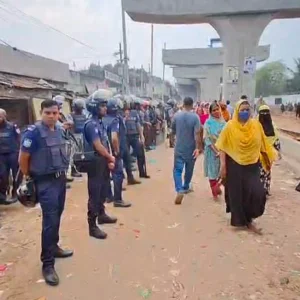
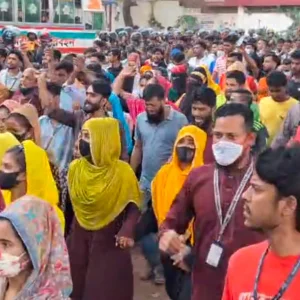
In the Savar-Ashulia industrial area, protests and unrest spread from October 31 demanding a minimum wage of 30,000 taka, and an end to blacklisting and dismissals of workers, and continued until November 5. Clashes, chases, vandalism, arson and road blockades occurred in various places between workers and police. Police used tear gas, sound grenades and rubber bullets to control the situation.
Because of the protests, a general holiday was declared in at least 25 factories on October 31. On November 2, according to industrial police, about 40 factories were closed. The next day, November 3, holidays were declared in more than a hundred factories. On November 4 the number exceeded two hundred. On November 5, production started in most factories, but at least 70 garment factories were still on holiday that day.
Industrial Police-1 Superintendent Mohammad Mominul Islam said at least 50 police members were injured in the clashes. The injured included Assistant Superintendent Shoaib Ahmed and Savar Model Police Station Officer-in-Charge Saiful Alam. Workers were also injured. In addition, on November 4, five journalists and media workers were attacked while gathering news in Hemayetpur.
Dhaka Range DIG Mostafizur Rahman said on Thursday that a total of eight cases were filed at Ashulia and Savar Model police stations over several days in connection with vandalism, arson and attacks at factories. More than a thousand unnamed people were accused in those cases. Police first reported 11 arrests. Later, the DIG said 40 people were arrested in one day in Dhaka, Gazipur and Narayanganj, in addition to other arrests at different times.
Police said on November 5 that the situation in the industrial area had become normal. However, workers' dissatisfaction over wages, safety and the work environment remained. According to those concerned, resolving workers' demands and ensuring a safe and normal production environment in factories are both needed to overcome the situation.
Khairul Mamun Mintu, legal affairs secretary of the Bangladesh Garments and Sweaters Workers Trade Union Centre, believes several days of factory closures will affect the export shipment schedule. In particular, there is pressure to complete most export activities in October and November ahead of Christmas in December.
Mintu said, "Because garment factories were closed for several days due to the movement, owners have come under pressure over shipments. Especially because most export activities were supposed to be completed in October and November centred on next December's Christmas, the production stoppage has created uncertainty about sending goods on time."
Mintu cited the role of effective trade unions in factories. In his view, if factories had effective trade unions, workers could have been given a clear idea in advance about their demands and the wage board's activities, and workers could have protested peacefully according to law. He said the situation reached a violent stage because there was no right to free trade unions in factories, and that the owners, the workers and the government administration also had failures in this regard.
Mintu also said some factories were already closed beforehand, and the disruption to production and shipments due to the movement is increasing the industry's crisis. In his words, if goods cannot be exported at the scheduled time, buyers' confidence may be damaged alongside owners' financial losses. About 4 million workers currently work in this industry; if factories close anew, many more workers risk becoming unemployed, he said.
Mintu emphasised workers returning to work while awaiting the wage board's decision, alongside ensuring their safety. He said, "Workers' demands and dissatisfaction over wages should be resolved through discussion. Workers should for now return to their workplaces and keep production running while awaiting the wage board's decision. But if panic is created among workers, returning to work will be difficult. So situations such as allegations of police searches or harassment at workers' homes must be stopped, and their safety and a normal work environment must be ensured."
Rafiqul Islam Sujon, central president of the Bangladesh Garments and Industrial Workers Federation, blamed non-implementation of labour law and delay in forming the wage board for the worker unrest. His allegation is that workers' fair demands are being ignored because of owners' political involvement and influence. He is unwilling to accept incidents of vandalism and anarchy as workers' actions.
Sujon said 35 workers' federations together have demanded a monthly minimum wage of 300 dollars, or about 36,000 taka. He said the new pay structure for government employees — a peon's basic pay of 20,000 taka and a maximum pay of 38,400 taka — was also taken into consideration in this regard. In his words, although the wage board was supposed to be formed in May, the matter has long been raised with the government and BGMEA.
Abu Bakr Siddique Khan, director of Savar's Odyssey Craft Private Limited, advised giving importance to reducing workers' cost of living alongside raising their wages. In his view, if house rent, transport, medical care and prices of daily necessities keep rising, workers will not fully get the benefit of a pay increase. He also spoke of the need to increase workers' skills and productivity.
Khan said a new worker's basic pay is 7,500 taka, but with compulsory two hours of overtime he receives 17,000 to 18,000 taka at the end of the month, with an attendance bonus also added. However, a new worker has to be trained for the first three months to become skilled. He also said that after receiving an order, there is usually pressure to complete shipment within 90 days; if a factory is closed for eight days within that period, it creates major pressure on the production and shipment schedule, and alongside buyers' confidence declining, the risk of business losses also increases.